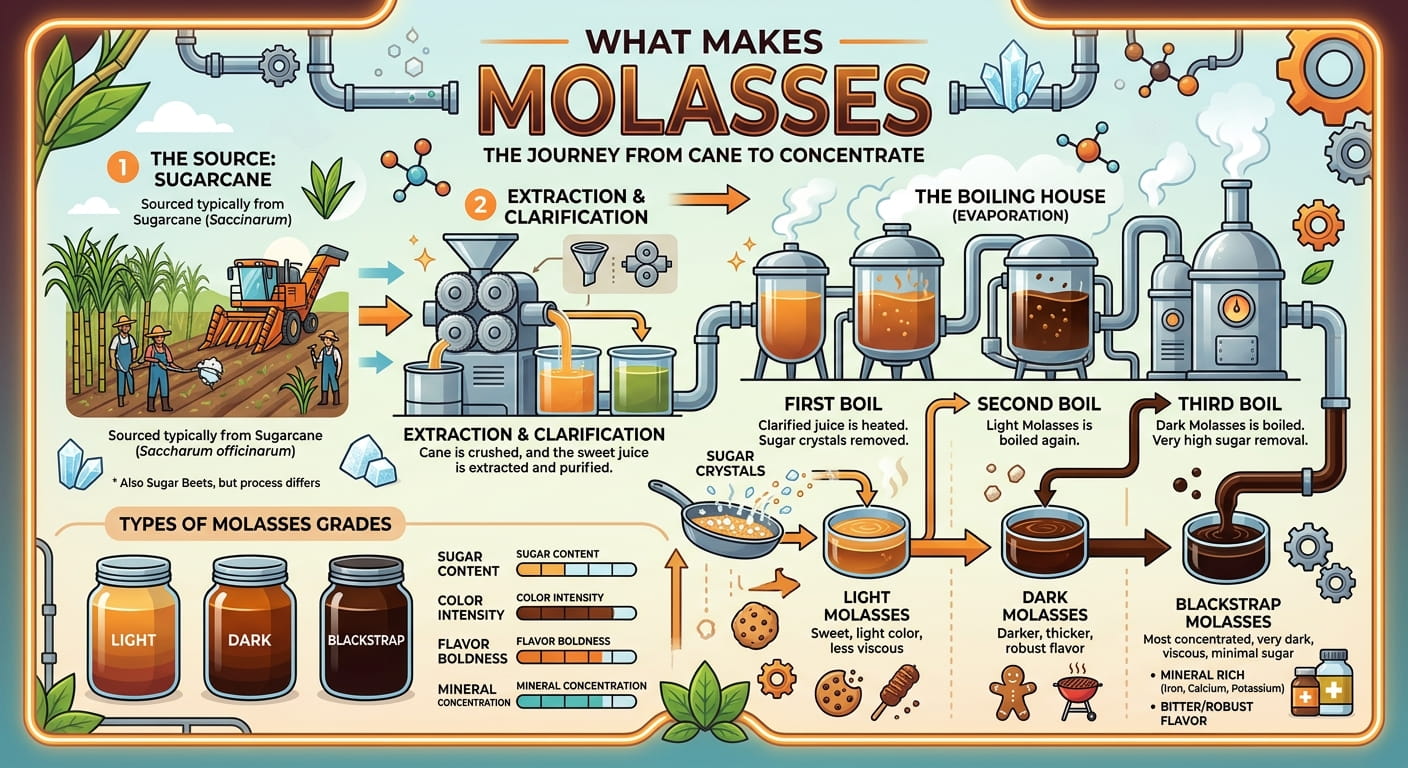
Molasses is made by boiling down the juice of sugar cane or sugar beet until sugar crystals form, then spinning the mixture in a centrifuge to separate the crystals from the dark syrup that remains. That leftover syrup is molasses . In essence, molasses is not manufactured as a product in its own right. It is the co-product of sugar refining, the thick, mineral-rich liquid that is left behind when the white crystals are taken out. This article explains the process step by step, covers the different grades that result from repeated boiling, and clarifies the British confusion between molasses and black treacle.
The Basic Process: From Plant to Syrup
The raw material is either sugar cane or sugar beet. Sugar cane is the dominant source for edible molasses, while beet molasses is typically too bitter for human consumption and is used in animal feed or fermentation .
Step One: Extraction
The cane is harvested, stripped of its leaves, washed and crushed to extract the juice. Hot water may be sprayed onto the crushed cane to soften it and draw out more sugar . The resulting juice is rich in sucrose, glucose and fructose, along with vitamins and minerals from the plant.
Step Two: Boiling and Crystallisation
The juice is boiled to concentrate it. As water evaporates, the sugar becomes supersaturated and begins to crystallise. This is the crucial stage: the sugar crystals that form are the valuable product, and the liquid surrounding them is what will become molasses .
Step Three: Centrifugal Separation
The mixture of crystals and syrup is spun in a centrifuge. This forces the liquid syrup away from the solid sugar crystals, much like a washing machine spin cycle removes water from clothes . The crystals are collected, dried and sold as sugar. The syrup that is flung off is molasses.
The Three Boilings and the Grades of Molasses
The process is not usually done once. Sugar cane juice typically goes through three cycles of boiling and crystallisation, and each cycle produces a different grade of molasses .
Light Molasses (First Boiling)
This is the syrup left after the first boiling. It is the lightest in colour, the sweetest, and the least viscous, because comparatively little sugar has been extracted at this stage. It is sometimes called Barbados molasses or first molasses .
Dark Molasses (Second Boiling)
The remaining syrup is boiled again, more sugar crystallises out, and the leftover liquid is darker, thicker and less sweet. It has a slight bitter edge compared with light molasses .
Blackstrap Molasses (Third Boiling)
The third and final boiling produces blackstrap. By this point, most of the sucrose has been removed. The syrup is very dark, extremely thick, and has a strong, almost bitter flavour. Paradoxically, because so much sugar has been taken out, the concentration of minerals, including calcium, magnesium, potassium and iron, is at its highest . This is why blackstrap is sometimes marketed as a health supplement, though it is still a sugar product and should be treated as such.
What About the Sugar Beet?
Sugar beet also produces molasses, but it is a different substance in practice. Beet molasses is roughly 50 per cent sugar by dry weight, mostly sucrose, but it contains salts and other compounds that make it unpalatable to humans . Its main uses are as an additive to animal feed (often called molassed sugar beet feed) or as a fermentation feedstock for industrial processes. If you buy a jar of molasses in a UK supermarket, it is almost certainly cane molasses.
The British Confusion: Molasses and Black Treacle
In the UK, the word “treacle” often appears where an American recipe might say “molasses”. The distinction is worth understanding.
Black treacle is a British product made by blending cane molasses with refiners syrup, a partially inverted sugar syrup. This blend softens the intense bitterness of pure molasses, producing a syrup that is dark and rich but slightly sweeter and more rounded in flavour . The EMBL-EBI chemical database describes molasses as “also called black treacle”, which reflects the common overlap in usage .
However, from a manufacturing perspective, they are not identical. Ragus, a UK sugar refiner, explains that black treacle is a formulated blend, while molasses is the pure co-product of sugar refining . For home baking, the two can often be substituted, though black treacle is milder and more versatile for sweet recipes, while pure molasses has a stronger, more bitter flavour that can dominate lighter bakes .
A common misconception is that they are completely interchangeable. In industrial formulations, the difference in flavour, colour and performance matters, and a recipe developed for one may not work identically with the other .
Sulphured Versus Unsulphured
You may see molasses labelled as “sulphured” or “unsulphured”. Sulphur dioxide was historically used as a preservative during the processing of young sugar cane, but it imparts a faint chemical taste. Molasses made from mature cane does not require this treatment, and is labelled unsulphured. Most molasses sold for home cooking today is unsulphured .
Frequently Asked Questions
What is molasses made from?
Molasses is made from the juice of sugar cane or sugar beet. The juice is extracted, boiled to crystallise the sugar, and spun in a centrifuge to separate the crystals from the syrup. The leftover syrup is molasses. Cane molasses is the type most commonly sold for human consumption, while beet molasses is usually used in animal feed or industrial fermentation .
How is molasses produced?
The process has three main stages: extraction of juice from crushed cane or beet, boiling to concentrate the juice and form sugar crystals, and centrifugal spinning to separate the crystals from the syrup. Cane juice typically undergoes this cycle three times, producing light, dark and blackstrap molasses in succession .
What is the difference between molasses and black treacle?
Black treacle is a British blend of cane molasses and refiners syrup, which makes it slightly sweeter and less bitter than pure molasses. Molasses is the direct co-product of sugar refining. They can often be substituted in home baking, but they are not identical in flavour or industrial performance .
Is molasses healthy?
Molasses, especially blackstrap, contains minerals including iron, calcium, magnesium and potassium . However, it is still a sugar product and should be consumed in moderation. It is not a substitute for medical treatment of any condition, and claims about its health benefits should be treated with caution. It is best understood as a flavouring ingredient with some trace nutrients, not a health food.