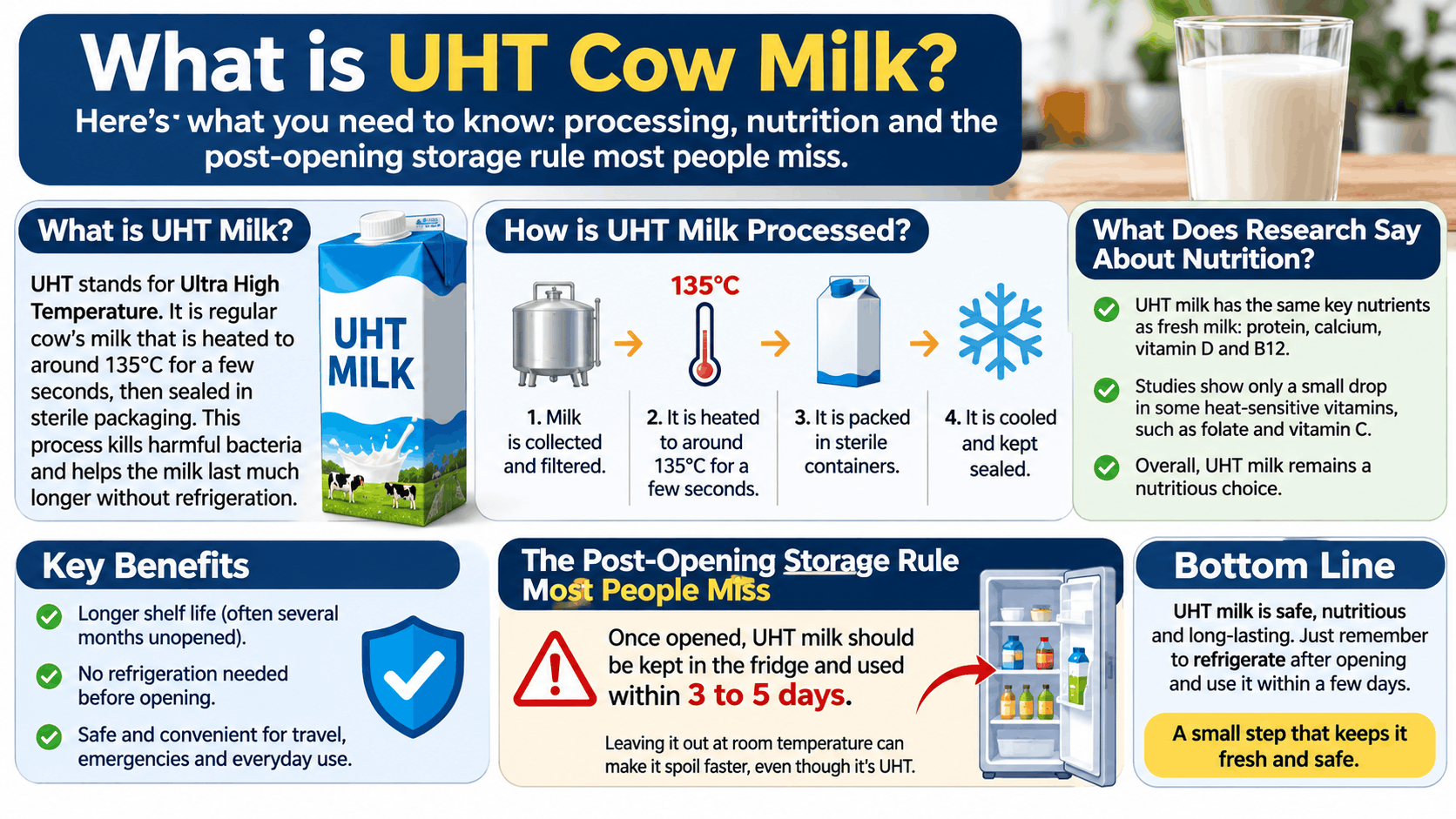
UHT cow milk is milk that has been heated to at least 135°C for a minimum of one second, then sealed in sterile packaging so it can sit on a shelf for months without refrigeration . That is the technical definition, and it explains why a carton in your cupboard can have a use-by date six months away. The more useful question is whether that process changes the milk in ways that matter for taste, nutrition and your shopping habits. This guide covers the process, the nutritional evidence, the storage rules that catch people out, and the honest trade-offs against fresh milk.
The Definition: Heat, Speed and Sterility
The UK Food Standards Agency sets the legal minimum: UHT treatment means heating a continuous flow of milk to not less than 135°C for not less than one second . In practice, commercial processors use 135–141°C for 3–6 seconds . The combination of very high heat and very short time is designed to destroy all spoilage micro-organisms and their spores while keeping the chemical and physical changes to the milk as small as possible .
This is different from sterilisation, which uses lower temperatures for much longer (around 120°C for 30 minutes) and affects the flavour more noticeably . It is also different from pasteurisation, which uses lower temperatures and produces milk that must be refrigerated and consumed quickly.
The sterile packaging is half the process. UHT milk is filled into pre-sterilised containers in a sterile atmosphere, which is why an unopened carton does not need a fridge .
The Nutritional Question: What the Evidence Says
This is where the claims get complicated, and the honest answer is that the research is not settled.
Protein and amino acids. A 2021 rapid review in a National Institutes of Health journal looked at human adult studies and found the evidence base is thin. One study suggested UHT processing reduced net postprandial protein utilisation, meaning less of the protein was retained by the body. But the review’s overall conclusion was that there is “no solid conclusions about the impact of heat treatment of milk on protein and lipid digestion” because the studies used different methods and few comparable controls . A 2025 animal study found that UHT treatment and storage actually accelerated protein digestion in rats, which could be beneficial for rapid nitrogen supply . The direction of the effect is not agreed.
Bioactive components. A 2025 review notes that UHT treatment degrades whey proteins (mainly beta-lactoglobulin) and breaks down fat in milk, while pasteurisation did not show significant effects on the same measures . Whey proteins are a source of bioactive peptides, so this is a real change. Whether it matters for long-term health is not established.
Calcium and protein bioavailability. One older animal study (1995) found that the biological value of protein and the apparent calcium digestibility were actually higher in the UHT group than in raw milk . This is a single study and should not be over-weighted, but it complicates the simple narrative that UHT is nutritionally inferior.
The practical summary is this: UHT milk is not nutritionally identical to fresh milk, but the differences are not clearly harmful, and the research does not support strong claims in either direction.
The Storage Rules That Catch People Out
The shelf-stable convenience of UHT milk has a hard limit, and it is the point where the carton is opened.
An unopened carton can be stored at room temperature until its expiry date . That is the whole point of the process.
Once opened, the rules change completely. The date markings no longer apply. The milk should be refrigerated at 4°C or below and consumed within the period stated on the packaging, which is usually two to seven days . The Centre for Food Safety advises marking the carton with the opening date and checking for signs of spoilage, such as a sour smell or texture changes, before use .
The mistake people make is treating an opened UHT carton like an unopened one. It is not. It is now a perishable product with a short fridge life.
The UK Context: Why UHT Is Having a Moment
The UK has traditionally been a fresh milk market. A European Commission decision from 1988 noted that the UK mostly consumed pasteurised milk and had a strong tradition of doorstep deliveries in glass bottles . That tradition shaped shopping habits for decades.
But the market is shifting. The Grocer reported in February 2026 that UHT is shedding its “poor man’s milk” image. In Spain, UHT accounts for over 95% of milk sales. In the UK, 19% of consumers still say they prefer fresh milk, which leaves a large proportion open to longer-life options . The article notes that milk is the third most wasted food and drink item in UK homes, with around 490 million pints thrown away each year, much of it because fresh milk goes off before it is used. UHT is presented as an obvious solution to that waste .
The plant-based sector is driving part of the shift. UHT plant drinks have grown while fresh has been flat, and the article argues that these products have shown UK shoppers that long-life does not have to mean lower quality .
The Honest Trade-Off: UHT vs Fresh
| Factor | UHT milk | Fresh (pasteurised) milk |
| Storage before opening | Room temperature, months | Refrigerated, days |
| Storage after opening | Fridge, 2-7 days | Fridge, a few days |
| Taste | Slightly cooked or caramelised note, varies by brand | Fresher, cleaner flavour |
| Protein digestion | Research inconclusive, some evidence of faster digestion | Baseline |
| Whey proteins | Degraded by heat | Better preserved |
| Waste risk | Low | Higher |
| Best for | Stock-up shopping, emergencies, cooking, households that use milk slowly | Everyday drinking, households that use milk quickly |
The taste difference is real but not universal. Direct steam injection systems produce fewer chemical changes and a flavour closer to pasteurised milk than indirect systems . If you have only tried one brand and disliked it, another may taste different.
Frequently Asked Questions
What is UHT cow milk?
UHT cow milk is milk heated to at least 135°C for a minimum of one second, then sealed in sterile packaging. This destroys spoilage micro-organisms and allows the unopened carton to be stored at room temperature for months .
Is UHT milk less healthy than fresh milk?
The research does not support a clear answer. UHT degrades some whey proteins , and one review found inconclusive evidence on protein digestion . But an animal study found UHT improved protein and calcium bioavailability , and a 2025 study found it accelerated protein digestion . The differences are real but not clearly harmful.
How long does UHT milk last after opening?
Once opened, UHT milk should be refrigerated at 4°C or below and consumed within two to seven days, or within the period stated on the packaging. The carton’s long shelf life applies only before opening .
Does UHT milk contain preservatives?
No. Pure UHT milk is a single-ingredient food with no preservatives or additives. The long shelf life comes from the heat treatment and sterile packaging, not from chemicals .