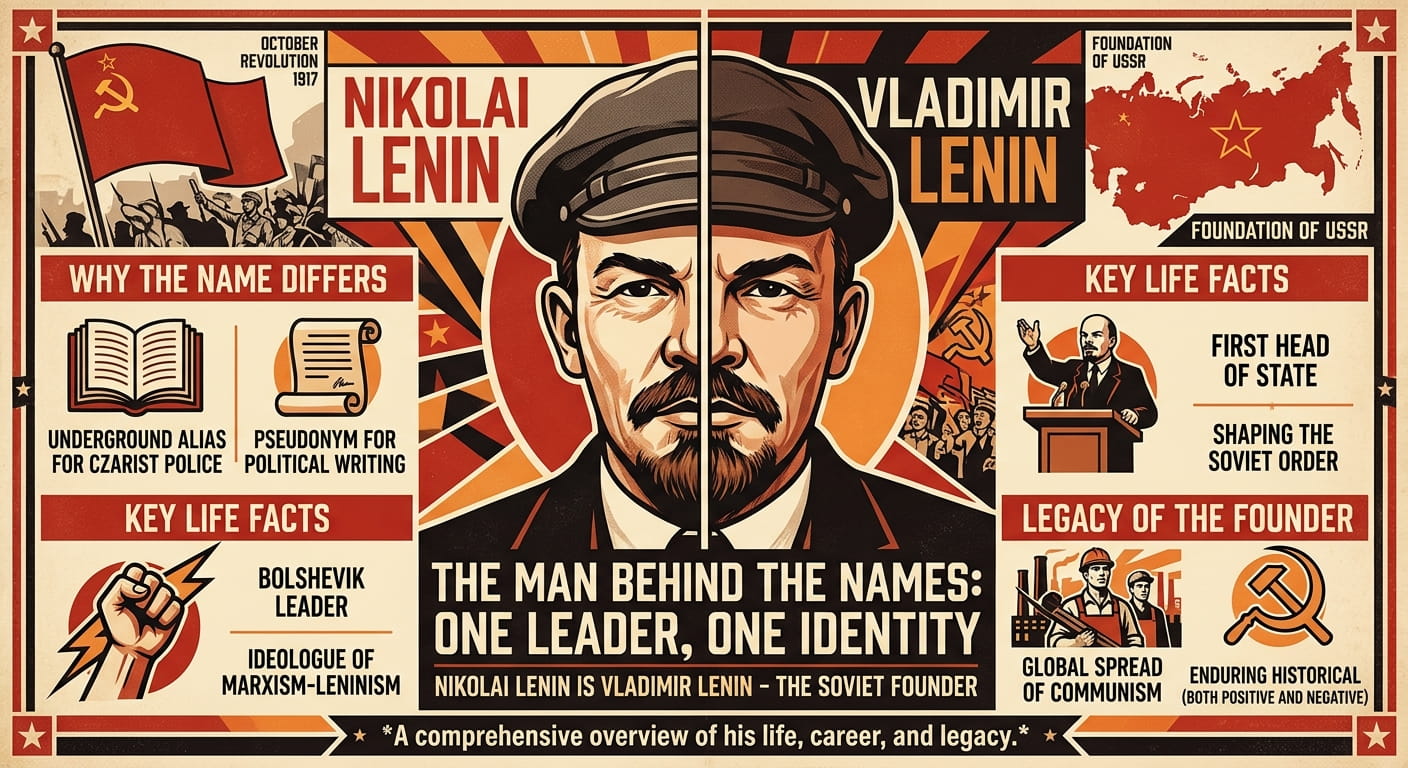
Nikolai Lenin is the same person as Vladimir Lenin, the Russian revolutionary who led the Bolsheviks to power in 1917 and founded the Soviet Union. The name “Nikolai” was not his birth name. He was born Vladimir Ilyich Ulyanov in 1870, and “Lenin” was one of several pseudonyms he used to evade the Tsarist police . The “Nikolai” variant appears in older English-language journalism, and it is the reason some readers encounter what looks like a different person. This guide explains the name, the key facts of his life, and the legacy that makes him one of the most consequential and contested figures of the twentieth century.
Why “Nikolai Lenin” and “Vladimir Lenin” Are the Same Person
The confusion is entirely linguistic. Lenin’s birth name was Vladimir Ilyich Ulyanov. He adopted the surname “Lenin” as a pseudonym, and it became the name by which the world knows him . The first name “Nikolai” was used in some Western press reports and publications during his lifetime, particularly in the United States.
A New York Times article from January 1921, for example, reported on the supposed death of “Nikolai Lenin” and noted that “Karpoff” was “an old pseudonym of Nikolai Lenin, the Soviet Premier” . A Time magazine report on his death in 1924 stated that “the real name of the late Premier and Dictator of Russia was Vladimir Ilich Ulianov,” but used “Nikolai Lenin” in the headline and opening sentence . The spelling was a convention of the era, not a different person.
The name “Nikolai” may have been chosen for its ordinariness, or it may have been one of several revolutionary aliases. What matters for a reader today is that “Nikolai Lenin” and “Vladimir Lenin” refer to the same historical figure.
The Key Facts of Lenin’s Life
Lenin was born in Simbirsk, on the Volga River, in 1870 . His father was a schools inspector who had attained a rank conferring nobility, and his family was respectable and educated . The defining event of his early life was the execution of his older brother, Alexander, in 1887 for involvement in a plot to assassinate Tsar Alexander III . That death turned Lenin towards revolutionary politics, though he rejected the individual terrorism his brother had embraced. He would reach his goal, he decided, by organising the proletariat as a class .
He studied law but never practised. He was arrested in 1896 for leading a textile workers’ strike, imprisoned for eight months, and exiled to Siberia for three years . After his exile he emigrated to Switzerland, where he became a leader of the Russian Social Democratic Labour Party. In 1903 he split the party, leading the Bolshevik faction .
He returned to Russia in 1917, after the February Revolution had overthrown the Tsar. In July of that year he made an unsuccessful attempt to seize power and was forced into hiding. In November, according to the Western calendar, the Bolsheviks overthrew the Provisional Government and Lenin became head of the new Soviet state . He suffered a stroke in 1922 and was largely incapacitated until his death in January 1924, at the age of 53 .
The Name and the Legacy
Lenin’s legacy is not a neutral subject, and any account of him has to acknowledge that. He was the founder of the Soviet Union, the architect of a one-party state, and the leader whose government used violence and terror to consolidate power. Robert Service’s biography describes him as bequeathing “a legacy of political oppression and social intimidation that has yet to be expunged” . That is one assessment, from a respected historian, and it reflects the dominant view in Western scholarship.
At the same time, Lenin was widely mourned at his death, and the New York Times reported in 1924 that black flags flew across Russia and that his death produced “a tremendous sensation” . The same report noted that he had been superseded by a triumvirate of Kamenev, Zinoviev and Stalin before his death, and that his “occult influence” continued to be felt.
The name “Nikolai Lenin” belongs to that complex history. It is the name used by the journalists who reported on him in the 1920s, and it is the name that appears in some of the earliest English-language accounts of the revolution. A reader encountering it today is encountering a historical spelling, not a different figure.
Frequently Asked Questions
Is Nikolai Lenin the same as Vladimir Lenin?
Yes. “Nikolai Lenin” is an alternative spelling used in some older English-language sources for Vladimir Ilyich Ulyanov, the founder of the Soviet Union. His birth name was Vladimir Ulyanov, and “Lenin” was a pseudonym. The first name “Nikolai” was a convention of early twentieth-century journalism, not a different person .
What was Lenin’s real name?
Vladimir Ilyich Ulyanov. He was born in Simbirsk in 1870. “Lenin” was a pseudonym adopted for revolutionary activity, and it became the name by which he is known historically .
Why did Lenin use a pseudonym?
Revolutionary activity in Tsarist Russia carried severe penalties, including arrest, exile and execution. Lenin was arrested in 1896 and exiled to Siberia, and he later lived in Switzerland . A pseudonym helped him evade the police and publish political writing without immediate detection. “Nikolai” was one of several names associated with him in Western press reports.
How did Lenin come to power?
He returned to Russia in 1917 after the February Revolution. In November 1917, the Bolsheviks overthrew the Provisional Government in what became known as the October Revolution. Lenin became the head of the new Soviet state . He had been building the Bolshevik faction since the party split in 1903.