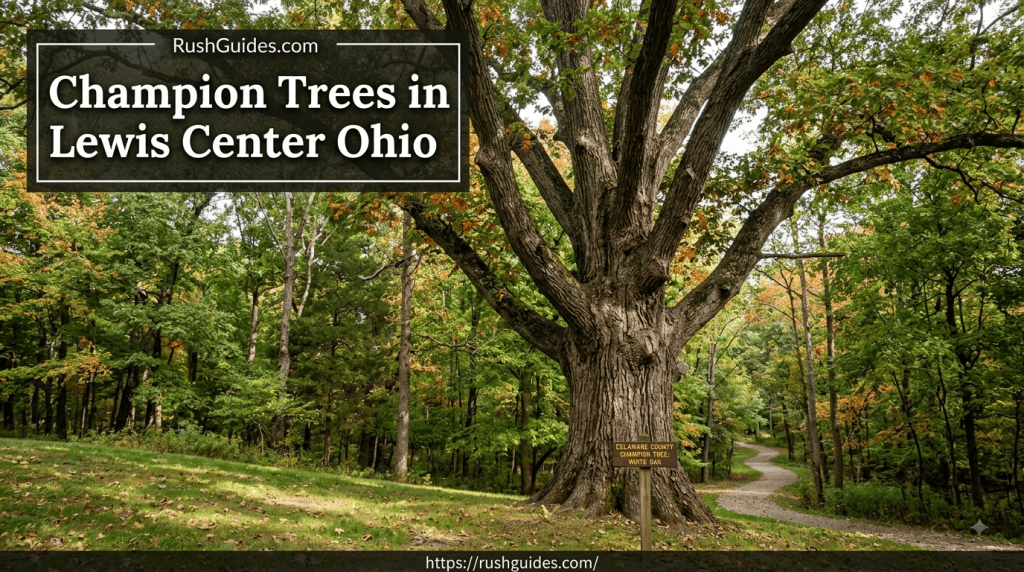
If you’ve never heard of champion trees, you’re missing out on one of the most fascinating outdoor pursuits in central Ohio. Lewis Center, a sprawling suburb just north of Columbus, sits right on top of some of the state’s most remarkable natural treasures, massive trees that have been standing for centuries, some dating back to before America was even founded.
These aren’t just big trees. Champion trees in Lewis Center, Ohio, are far more than oversized plants. They are living records of ecological resilience, historical continuity, and community identity. They’re proof that nature doesn’t rush, and sometimes the most impressive things are hiding right where you’d least expect them.
What Makes a Tree a Champion?
The term “champion tree” sounds official, and it is. Ohio’s Champion Tree Program is a voluntary endeavor to locate, measure, record, and appreciate the largest tree species in our state. But here’s the thing: it’s not just about size alone.
Champion trees are identified through consistent, precise measurements: Trunk Circumference is measured at breast height (about 4.5 feet above the ground) in inches. Tree Height is recorded from base to highest living point (feet). Crown Spread is determined by averaging the widest and narrowest parts of the canopy (feet).
All three measurements feed into a scoring formula that decides which tree reigns supreme for its species. Total score = Circumference (inches) + Height (feet) + ¼ × Average crown spread (feet). This scoring system means a tree doesn’t have to be the tallest to be a champion; a thick trunk with a massive crown can outscore a skyscraping competitor.
Ohio is currently home to 14 National Champion Trees on the Champion Trees registry. Some of those specimens are scattered around the state, and quite a few impressive ones are hiding in and around Lewis Center.
The Champions You Can Actually Visit
Lewis Center offers more than just suburban sprawl and shopping centers. The region sits along the Olentangy River, an area with rich glacial soil and enough water to help trees reach extraordinary sizes. Here’s where the giants live.
Highbanks Metro Park: The Crown Jewel
Highbanks Metro Park, located at 9466 Columbus Pike (US Rt 23 N) in Lewis Center, Ohio, is one of Central Ohio’s most celebrated parks. Spanning over 1,200 acres, Highbanks is named for its dramatic 100-foot shale bluffs that overlook the Olentangy River.
But the bluffs aren’t the only reason to visit. The park features two large sycamore trees; the trees are 23-24 feet in circumference, and reportedly 500 years old. Let that sink in: these trees were already massive when the American colonies were being founded. You can actually walk up to them on the park’s accessible trails and feel insignificant by comparison.
The shorter, ADA-accessible loops follow the riverbank and are essential for viewing the massive sycamores and cottonwoods of the riparian forest. If you’re planning a visit, these floodplain trails offer the most dramatic encounters with giant trees without demanding serious hiking chops.
Highbanks is also a birdwatcher’s paradise, known for its nesting bald eagles and ancient sycamore trees. So if tree spotting gets dull, you might catch sight of a bald eagle nest from above.
Alum Creek State Park
If Highbanks draws too many crowds for your taste, Alum Creek is another great place to explore. It may not always be as famous as Highbanks, but it has its own charm. The soil here stays moist, which helps trees grow quickly. The park hosts large cottonwoods and mature oaks, perfect for a quieter afternoon walk.
Why This Region Grows Giants
You might wonder why Lewis Center ended up with so many massive trees. It’s no accident. Areas along the Olentangy and Scioto rivers feature deep, fertile soils that encourage deep root systems and massive growth. Central Ohio’s climate offers ample rainfall and warm summers, allowing trees to put on substantial annual growth.
Add in the fact that some of these trees have been protected on public land for decades, and you’ve got the perfect recipe for arboreal superstars.
The Species That Dominate
Not all trees grow equally. Some species are just built for size.
White Oaks: The Long-Lived Legends
White oaks are among the most iconic champion trees in Ohio. Known for their massive trunks and sprawling branches, some specimens near Lewis Center are estimated to be 200–300 years old. These trees are slow growers, but they’re also incredibly tough. They’ve survived droughts, storms, and centuries of environmental change.
American Sycamores: The Widest Monarchs
White Oak: White oaks are a staple of Ohio’s forests. Known for their sturdy trunks and large canopies, these trees can grow to exceptional heights and girths. But if you want to see the most visually shocking champions, hunt down the sycamores. One of the most amazing things here is the sycamore trees. These trees can grow extremely wide. Some have trunks so big that it would take several people to wrap their arms around them.
Sycamore bark is striking too mottled white, gray, and brown patches that make the trees feel almost abstract when you stand in front of them.
Eastern Cottonwoods: The Floodplain Giants
Eastern Cottonwoods (Populus deltoides) grow alongside the sycamores in the floodplain, their triangular leaves creating a distinctive aesthetic. These trees love water, so you’ll find the biggest specimens near river corridors.
How to Hunt for Champion Trees Yourself
Want to get involved? The Ohio Department of Natural Resources makes it surprisingly accessible.
Ohio has an official Big Tree Program managed through the Ohio Department of Natural Resources (ODNR). This program maintains a registry of the largest known trees for each species across the state. Anyone can nominate a tree.
If you spot what you think might be a record-breaker, here’s what to do:
If you spot a large tree you believe might qualify for champion status, you can measure and submit your findings to the ODNR Division of Forestry. Detailed guidance on how to nominate a tree including required photos and measurements is available on the ODNR site.
The process isn’t complicated. You’ll need accurate measurements at breast height, total height, and crown spread. A measuring tape, a ladder, and some basic geometry gets you there. Many residents have become “big tree hunters,” treating championship nomination like a grown-up version of treasure hunting.
Why These Trees Matter
At first, it might seem like champion trees are just a quirky obsession for nature nerds. But there’s real substance here.
The program also encourages public awareness of forest conservation and the ecological value of large trees. These giants provide shade, clean air, storm protection, and habitat for wildlife. In a region experiencing rapid suburban development, they’re also a physical reminder of what Ohio’s landscape looked like before strip malls and subdivisions took over.
Highbanks Metro Park, established in 1973 and designated a National Natural Landmark in 1980, is a living museum of Ohio’s natural and cultural history. The park’s bluffs and ravines were carved by glacial meltwater over 10,000 years ago, and the land was home to indigenous cultures, including the Adena and Cole, who left behind ceremonial mounds and earthworks. Trees are part of that story, witnesses to human history as much as geological history.
Protection and Preservation
Here’s something important to understand: Designation as a Champion Tree through this program does not confer any special legal status, ownership, or protection. If a champion tree stands on private property, it’s not automatically protected by law.
That said, many Lewis Center residents and local municipalities take stewardship seriously. While champion trees on private property do not automatically receive legal protection, many municipalities and homeowners associations in Ohio have tree preservation ordinances that restrict removal or loss of large trees. Always check local ordinances before any development or major landscaping.
Planning Your Visit
Most champion trees are in public parks, so access is straightforward. Start at Highbanks Metro Park if you’re new to this. The trails are well-maintained, the trees are genuinely massive, and the setting is beautiful enough that even if you’re not obsessed with dendrochronology, you’ll have a great time.
Highbanks Metro Park is the most visited Metro Park in the Columbus and Franklin County Metro Parks system, attracting around one million visitors annually. Crowds are heaviest on weekends and pleasant spring/fall weather days. Go on a weekday or in the early morning for a quieter experience.
Bring a camera. These trees are photogenic in ways you won’t expect until you’re standing in front of one. The scale is hard to capture in photos, but you’ll try anyway, and that’s part of the fun.
What’s Next for Lewis Center’s Giants
Local conservationists and the Ohio Department of Natural Resources (ODNR) have intensified their efforts this year to document these specimens. The Ohio champion trees Lewis center ohio registry is a living list that evolves as new giants are discovered and measured.
As more people learn about these trees, interest in tree hunting has grown. New champions get nominated every year, and some private landowners have started sharing access to their massive trees. It’s a quiet conservation movement built on curiosity and respect for nature.
The takeaway: if you live in or near Lewis Center, you have some of the state’s most remarkable natural features in your backyard. Stop driving past them. Get out there, measure a trunk, stand beneath a 500-year-old sycamore, and feel connected to a living piece of Ohio’s real story.
Read More About: Letesha Marrow