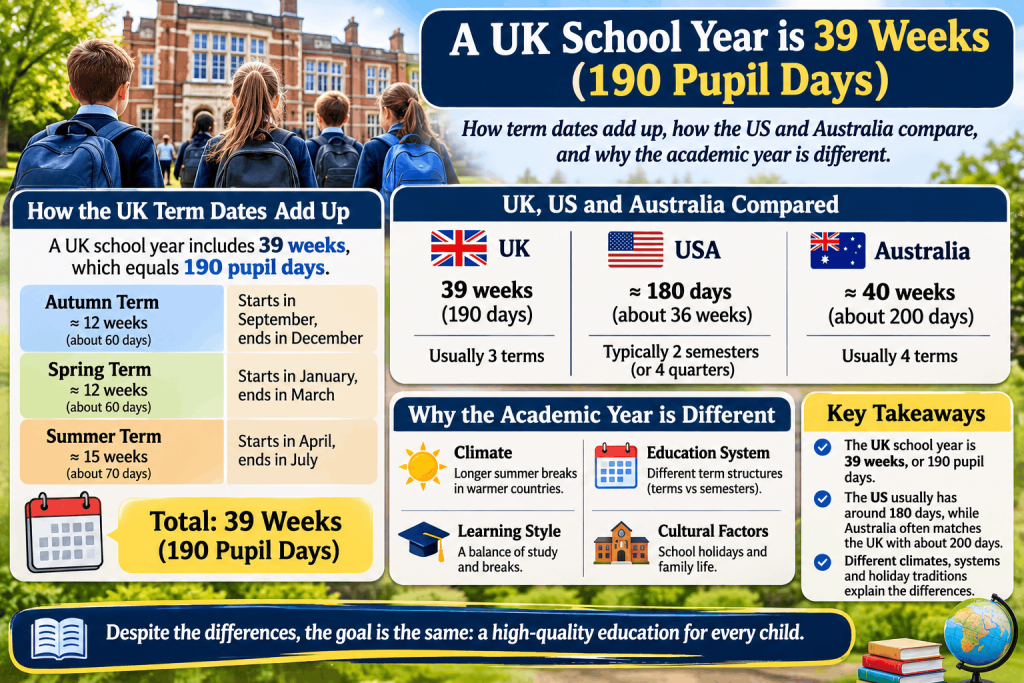
How many weeks in a school year depends on where you are. In the UK, the standard answer is 39 weeks of education for pupils, though the total number of days schools are open is often 195 (39 weeks), with five of those days reserved for teacher training . In the US, the school year is typically 36 weeks (180 instructional days), while Australia sits around 40 weeks (200 days) . This guide focuses on the UK system, explains the difference between the school year and the academic year, and shows how term dates add up to the total.
The UK Answer: 39 Weeks of Education
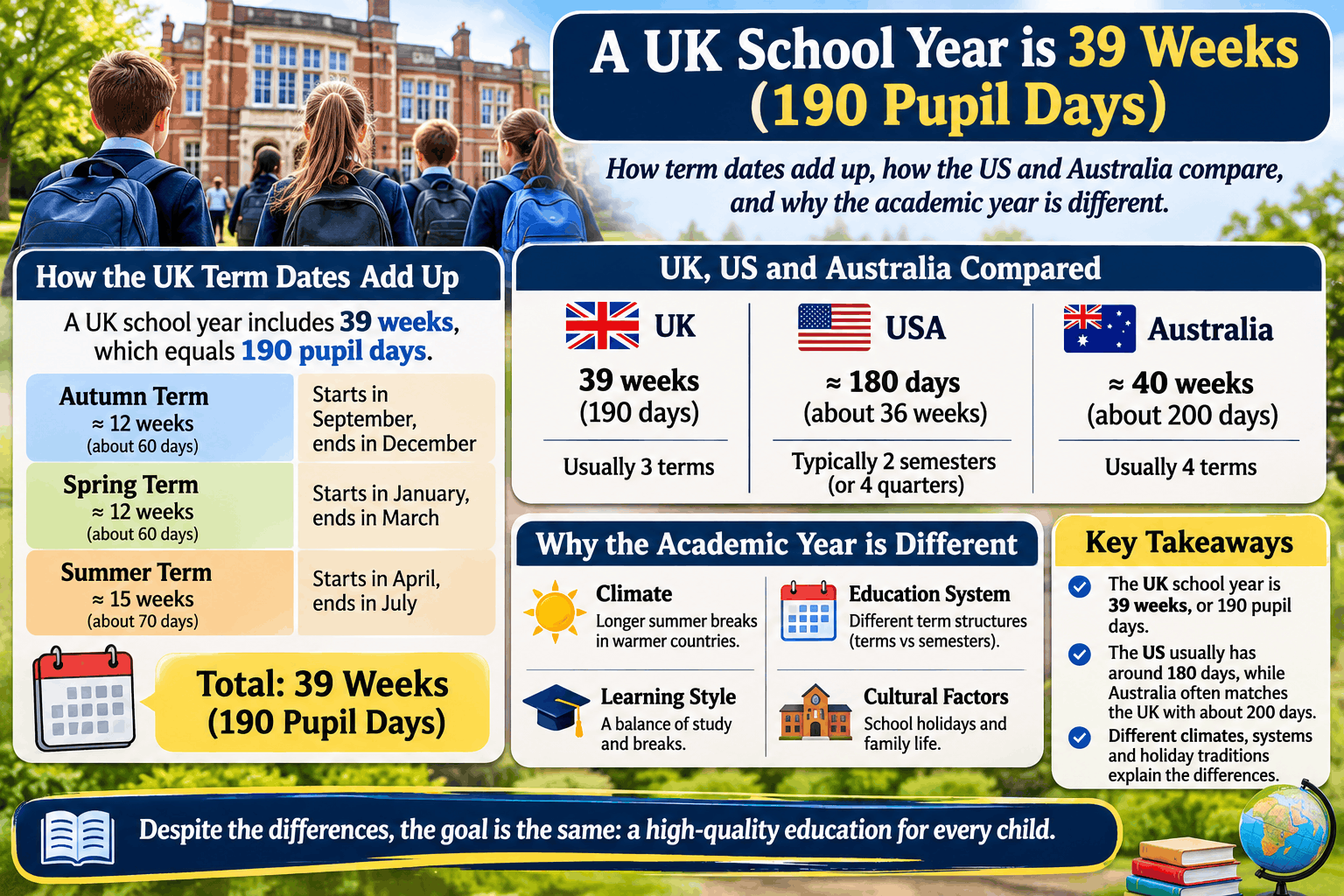
For schools funded by local authorities in England, the requirement is 190 days of education, which works out to 39 weeks . This is the figure to use if you are asking how many weeks your child is actually in lessons.
The slightly higher figure of 195 days (also 39 weeks) appears frequently because it includes 5 INSET days (in-service training days) when teachers are working but pupils are not in school . So the school is open for 195 days, but pupils attend for 190. Both figures correspond to 39 weeks, because the INSET days fall within the same weekly structure.
A Birmingham City Council page states this clearly: “There are 195 school days in each year (39 weeks). Pupils spend 190 days (38 weeks) in school each year; 5 of the 195 days are reserved for training teachers and support staff” . The “38 weeks” figure in that sentence is slightly confusing, because 190 days divided by five days per week is 38 weeks. The discrepancy arises because the 195-day total spans 39 calendar weeks when you include the INSET days and bank holidays. For practical purposes, 39 weeks is the standard answer for the school year’s span.
How the Terms Add Up
Term dates vary by local authority, but a typical pattern shows how the weeks are distributed. Rochdale Borough Council’s recommended pattern for 2026-27 gives 15 weeks in the autumn term, 11 weeks in the spring term, and 14 weeks in the summer term . That totals 40 weeks, which is one more than the 39-week standard. The difference is likely due to how half-term weeks are counted (a half-term week is still part of the term’s calendar span, even if pupils are off). The precise distribution varies between councils, but the total instructional days remain around 190.
Surrey County Council’s decision for 2026-27 notes that “the school year will still have 195 days, including 5 INSET days” , confirming that the total is fixed even when the pattern of holidays changes.
The Difference Between the School Year and the Academic Year
The school year is the period pupils are in education, which is the 39-week figure above.
The academic year is the full 12-month cycle from September to August. It includes the school year plus all the holidays: summer, Christmas, Easter and half-terms. If someone asks how many weeks are in an academic year, the answer is 52 (or 53, depending on how the calendar falls), because that is the length of the calendar year . But if they ask how many weeks of school there are, the answer is 39.
This distinction matters for planning. A parent arranging childcare needs to know about the 13 weeks of school holidays, not the 39 weeks of term time. A teacher’s contract is usually expressed in terms of the 195-day school year, not the full calendar.
How the UK Compares Internationally
The UK’s 39 weeks sits in the middle of the international range.
United States: The school year is typically 180 instructional days, which is 36 weeks. A traditional US school calendar describes two 18-week semesters constituting 180 instructional days . A Spanish educational document on the US system also states 180 days .
Australia: Students attend for 200 days a year, which is 40 weeks. The year is divided into four terms of 9 to 11 weeks each . A Victorian school’s 2026 dates show terms of 10, 10, 9 and 9 weeks, totalling 38 weeks of term time .
India (Maharashtra): A 2026 circular states that teaching and learning activities will be conducted on 210 days, spread across 35 weeks, with six working days per week . The six-day week is the key difference.
| Country | Instructional days | Weeks (approx.) |
| UK | 190 (pupils) | 39 |
| US | 180 | 36 |
| Australia | 200 | 40 |
| India (Maharashtra) | 210 | 35 (six-day week) |
Common Misunderstandings
“The school year is 52 weeks.” No. The calendar year is 52 weeks. The school year, meaning the period of education, is 39 weeks in the UK. The remaining 13 weeks are holidays.
“195 days means 195 school days for pupils.” No. 195 is the number of days the school is open. Pupils attend for 190 of those days. The other five are INSET days .
“All UK schools have the same term dates.” No. Local authorities set their own term dates, and academies and free schools can set their own. The 190-day requirement applies to local authority schools, but the pattern of terms and half-terms varies .
“The academic year and the school year are the same thing.” No. The academic year is the full 12-month cycle. The school year is the 39 weeks within it when pupils are in lessons.
Frequently Asked Questions
How many weeks are in a UK school year?
Pupils in local authority schools in England are entitled to 190 days of education, which is 39 weeks . Schools are open for 195 days (also 39 weeks), with the extra five days used for teacher training . The exact term dates vary by council.
How many weeks are in a school year in the US?
The US school year is typically 180 instructional days, which is 36 weeks. It is usually divided into two 18-week semesters .
Is a school year 39 or 40 weeks?
In the UK, the standard is 39 weeks. Some local authority term patterns span 40 calendar weeks because of how half-terms fall, but the instructional requirement is 190 days, which is 38 weeks of five-day attendance. The 39-week figure includes the INSET days .
How many weeks of holiday are in a school year?
If the school year is 39 weeks and the calendar year is 52 weeks, there are 13 weeks of holiday in a typical academic year. This includes the summer holiday (usually around six weeks), Christmas and Easter holidays, and half-term breaks.