“Betting betting tips” is a search that usually leads to someone else’s selections. That is the wrong place to start. A tip is only useful if you understand what it is built on: the odds, the implied probability, and the bookmaker’s margin. Without that, you cannot tell a genuine insight from a confident guess. This guide explains how betting odds actually work, how to calculate the bookmaker’s edge, and the practical rules that separate a considered bet from a hopeful one.
How Betting Odds Work
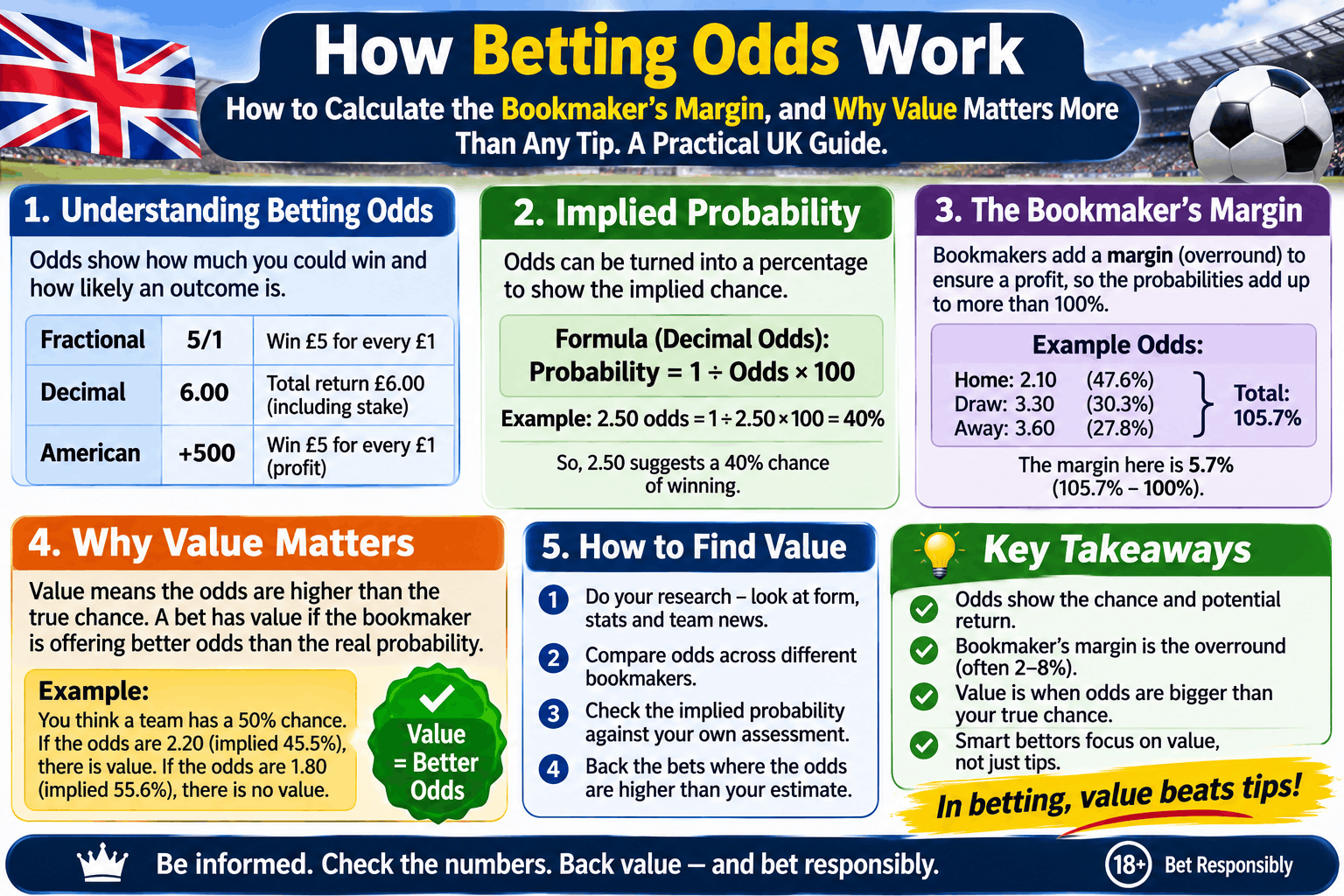
Odds are a price. They tell you how much you will win if your bet comes in, and they imply a probability that the bookmaker believes the outcome has.
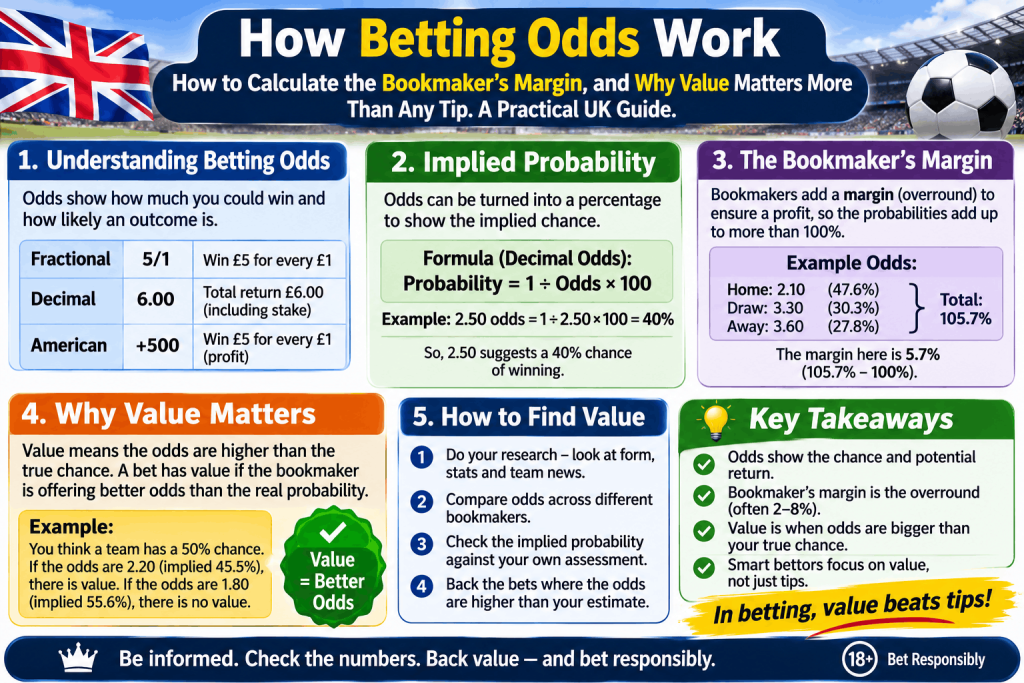
In the UK, you will see three formats. Decimal odds are the most common on major sites. They represent the total return, including your stake. Odds of 3.50 mean a £1 bet returns £3.50 if it wins . Fractional odds, still common in horse racing, are expressed as a ratio. 5/1 means you win £5 in profit for every £1 staked . American odds, or moneyline odds, use a plus or minus sign. A -200 favourite means you must stake £200 to win £100. A +350 underdog means a £100 bet wins £350 .
The format changes the presentation, not the underlying logic. Every set of odds implies a probability.
The Key Skill: Calculating Implied Probability and the Bookmaker’s Margin
This is where most casual bettors stop, and it is where the value lies.
To convert decimal odds to implied probability, divide 1 by the odds and multiply by 100. Odds of 2.00 imply a 50% chance. Odds of 4.00 imply a 25% chance.
Now do that for every outcome in a market. In a football match with a home win, draw, and away win, add the three implied probabilities together. If the bookmaker has priced the market fairly, the total should be 100%. It never is. The total will be higher, and the excess is the bookmaker’s margin, also called the overround .
Take a worked example from a betting analysis guide. A strong team is priced at 1.50 to win, the draw at 4.00, and the weak team at 6.00. The implied probabilities are 66.6%, 25%, and 16.6%. The total is 108.2%. That extra 8.2% is the bookmaker’s built-in profit .
This matters because it tells you what you are up against. The bookmaker does not need to predict every result correctly. It needs to price the market so that the margin covers the outcomes. Your task is to find selections where your own assessment of the probability is higher than the implied probability in the odds. That is what “value” means.
Why “Tips” Are Not the Same as Value
A tip is a selection. Value is a relationship between your assessment and the price. They are not the same thing.
A tip can be correct and still be a bad bet. If a team is almost certain to win, the odds will be very short, and the return may not justify the risk. A tip can be wrong and still be a good bet, if the price was generous enough to compensate for the risk. The result of a single bet tells you nothing about whether the bet was wise.
This is why the search for “betting betting tips” can be misleading. The tips might be right. But without the odds context, you cannot judge whether they were worth backing.
The Bankroll Rules That Matter More Than Any Tip
Even a good tip is worthless if you stake too much on it. The most common reason people lose money betting is not bad selection. It is bad staking.
The standard approach is to stake a fixed percentage of your bankroll on each bet, typically 2% to 5%. If your bankroll is £100, that means £2 to £5 per bet. This keeps a losing run from becoming a catastrophe, and it removes the emotional urge to chase losses by staking more.
Flat betting, where you stake the same amount on every bet regardless of confidence, is a simple way to enforce this discipline. It is less exciting than varying stakes, but it is more sustainable.
The UK Responsible Gambling Context
If you are betting in the UK, you should be using a bookmaker licensed by the Gambling Commission. Licensed operators are required to offer deposit limits, loss limits, session time limits, and self-exclusion tools .
GAMSTOP is the national self-exclusion scheme. A single registration blocks you from all participating UK-licensed sites for a minimum of six months . GamCare runs a free helpline on 0808 8020 133, available 24 hours a day .
These tools exist because gambling harm is real. If you find yourself betting with money you need for something else, or hiding your betting from people close to you, that is a sign to stop and use the support available.
Frequently Asked Questions
How do betting odds work?
Odds are a price that implies a probability. Decimal odds show the total return including stake (3.50 means £1 returns £3.50). Fractional odds show profit (5/1 means £5 profit per £1). American odds use plus or minus to show how much you need to stake or can win . The implied probability is calculated as 1 divided by the decimal odds, multiplied by 100.
What is the bookmaker’s margin or overround?
It is the built-in profit in the odds. If you add up the implied probabilities of all outcomes in a market, the total is always more than 100%. The excess is the margin. For example, if the three outcomes in a football match add up to 108.2%, the margin is 8.2% . The higher the margin, the worse the value for the bettor.
Are betting tips reliable?
A tip is only as good as the reasoning behind it. Many tips are presented without any explanation of the odds or the probability assessment. A tip can be correct and still be a bad bet if the price is too short. The useful skill is not finding tips, but learning to assess whether the odds offer value relative to your own research.
How much should I bet on a single selection?
A common guideline is 2% to 5% of your total betting bankroll. If your bankroll is £100, that is £2 to £5. This limits the damage of a losing run and helps you avoid chasing losses. Set a budget before you start and never bet money you need for other things.