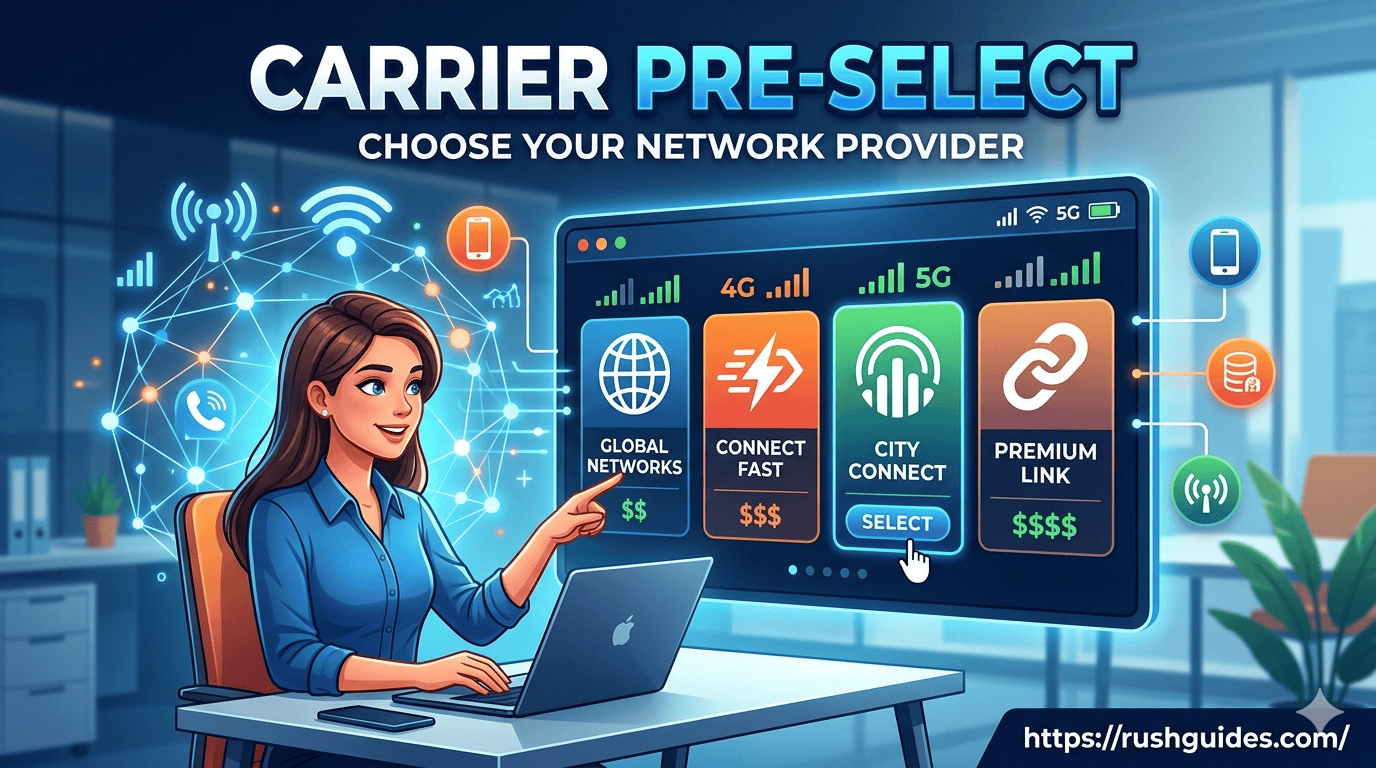
That’s the entire premise of carrier pre select (CPS), and it’s a concept that’s been quietly saving UK businesses money on call bills for decades. If you’ve never heard of it, you’re not alone — over 54% of UK businesses are charged for services they no longer require, and most of them have never stopped to compare their call rates against what else is out there.
CPS is one of those telecom features that does exactly what it says: you pre-select a carrier, and your calls automatically route through that provider instead of your default one. No special codes, no new hardware, no changing your number. The savings, though, can be real.
Here’s everything you need to know about how it works, who it’s still useful for, and what the UK’s upcoming PSTN switch-off means for its future.
What Is Carrier Pre Select?
Carrier preselect is a method of routing calls for least-cost routing without the need for programming of a PBX telephone system. It’s the process whereby a telephone subscriber whose line is maintained by one company — usually a former monopoly provider like BT — can choose to have some or all of their calls automatically routed across a different telephone company’s network, such as TalkTalk, without needing to enter a special code or special equipment.
Put simply: your physical phone line stays with BT (or whoever laid the copper). Your outgoing calls get handed off to a different provider at the exchange level, one that may charge you significantly less per minute.
Carrier pre select is a regulator-imposed system that compels telecoms networks to allow customers to route their calls through a competitor’s network. The importance of CPS is that it allows competitors to use an incumbent’s infrastructure. That regulatory background matters — this isn’t just a commercial arrangement. Ofcom mandated it as a way to open up the UK telecoms market and give consumers and businesses a genuine choice.
How Does It Actually Work?
The mechanics are straightforward, and that’s genuinely one of its best features.
When a customer dials a number, the call is initially sent to the local exchange. Instead of routing the call through the default provider, the exchange recognises the CPS agreement and redirects the call to the pre-selected carrier. The chosen carrier then processes the call at its designated rates, and the recipient receives it normally.
There is no installation or programming of equipment required and you don’t have to dial a code to activate the service. When you sign up to a secondary supplier and use the method of Carrier Pre-Selection, your local telephone exchange will automatically re-route all your calls to the secondary supplier’s network.
You keep your number. You keep your line. You keep everything exactly as it is. The only thing that changes is who charges you for the calls you make — and at what rate.
Carrier preselect can cover local, national, international, or mobile calls, depending on the service options available from the provider. That flexibility means you could, in theory, use one CPS provider for international calls and your default provider for local ones — though in practice most businesses pick a single provider to handle everything.
The Business Case: How Much Can You Save?
This is where CPS gets interesting for anyone running a business with a decent call volume.
Depending on outbound call volumes, savings can be as high as 55% on business calls and 27% on line rentals compared with BT. Those figures are from one CPS provider’s own marketing, so take them as the optimistic end of the range. Real-world savings will depend on your current rates, call types, and which CPS provider you switch to.
After having their business telephone lines installed, many companies find that the call rates with their provider are significantly higher than those of other service providers. CPS does not involve auto-diallers, PBX programming or manual prefix codes. You can keep your existing telephone numbers, lines and equipment and continue to operate as usual.
For comparison, businesses switching from ISDN or traditional landlines to hosted VoIP typically save 30–60% on their total telephony costs — so CPS sits in a similar ballpark if you’re specifically looking to cut call costs without a full infrastructure overhaul.
The types of businesses that tend to get the most out of CPS are:
- Offices with multiple lines making frequent long-distance or international calls
- Businesses locked into existing BT line contracts but unhappy with call rates
- Companies that aren’t yet ready (or able) to migrate to VoIP or SIP trunking
- Organisations needing predictable call routing without technical complexity
Carrier pre select is closely related to least cost routing (LCR). Least cost routing means selecting the cheapest available telecom route for calls. CPS helps automate this process by directing calls through cost-effective carriers.
Carrier Pre Select vs VoIP vs SIP Trunking
If you’ve been researching business phone costs, you’ve probably run into these three terms together. They’re related but not the same thing.
Carrier Pre Select (CPS) works over your existing copper phone line. It’s a lightweight solution that changes who handles your outgoing calls at the exchange level. No internet dependency, no new hardware, minimal disruption.
VoIP (Voice over Internet Protocol) moves your calls entirely onto your internet connection. Your voice is converted into digital data packets and transmitted online. It’s more modern, often cheaper, and much more flexible — but requires a stable broadband connection and may mean replacing phones or adding adapters.
SIP Trunking is the enterprise version of VoIP. A SIP trunk is a service that connects your business phone system to the internet, while VoIP is the broader technology for making calls over IP networks; SIP trunking functions as one method within the VoIP ecosystem. It’s designed for businesses already running PBX systems that want to connect those systems to the internet rather than traditional copper lines.
The honest summary: CPS is the lowest-friction option for businesses on copper lines who want to reduce call costs without touching anything else. VoIP and SIP trunking offer more features and often better long-term economics, but they require a more substantial migration.
The PSTN Switch-Off: What It Means for CPS
Here’s the part that changes everything about the CPS conversation.
The BT switch-off is confirmed for 31 January 2027. BT Openreach extended the original December 2025 deadline by 13 months to allow more time for vulnerable customer migration. After this date, all PSTN and ISDN services will permanently cease.
CPS runs on top of copper PSTN infrastructure. When the PSTN goes dark, CPS goes with it.
On 5th September 2023, the UK national ‘stop sell’ came into effect. This means every provider in the UK has stopped selling traditional phone lines and fibre to the cabinet (FTTC) broadband. Additionally, no changes can be made to your legacy telephony infrastructure.
The switch to IP technology also impacts other equipment using PSTN, ISDN or ADSL — including alarms, lift lines, point-of-sale machines, and telecare devices. So if your business still relies on legacy analogue infrastructure for anything beyond just calls, the 2027 deadline affects you on multiple fronts.
The practical implication: if you’re currently using CPS as your primary cost-saving measure, you have until January 2027 to plan a migration to IP-based calling. That sounds like plenty of time, but only one in five businesses are fully aware of the PSTN switch-off, while 59.7% are unsure what it means altogether. Don’t be in that group.
How to Get Set Up With Carrier Pre Select
The process is simpler than most telecom migrations.
- Check your current call costs. Get three months of call bills and identify where you’re spending the most — national, international, or mobile calls.
- Compare CPS providers. Providers like Midland Networks, Numeric Futures, and UK IT Networks all offer CPS services with least-cost routing. Most will compare your current rates against theirs before you commit.
- Sign a CPS agreement. Your new provider contacts BT (or your line provider) on your behalf and registers the pre-selection at the exchange level.
- Calls route automatically. Your local telephone exchange will automatically re-route all your calls to the secondary supplier’s network. No downtime, no changes on your end.
- Review the contract terms. Review service terms carefully: call rates, destinations covered, setup fees, contract length, and cancellation details. Check if your phone line supports carrier pre select — not all telecom setups offer it in the same way.
One thing worth noting: with the PSTN stop-sell already in effect since September 2023, new CPS arrangements on legacy lines are becoming harder to set up in certain areas. If you’re in a location where Openreach has already begun its FTTP rollout, your options may be limited. It’s worth confirming with a provider before assuming CPS is available on your line.
Is Carrier Pre Select Still Worth It in 2026?
That depends on your situation.
If your business is still on legacy copper lines, makes a high volume of outgoing calls, and hasn’t yet migrated to VoIP or SIP trunking, CPS can absolutely still reduce your monthly telecom bill. The savings are real, the setup is simple, and the disruption is minimal. Many organisations continue using CPS because it offers stable and predictable call routing.
That said, with the PSTN switch-off set for January 2027, CPS is approaching its end of life. The smarter move for most businesses at this point is to use CPS as a short-term cost fix while actively planning a migration to hosted VoIP or SIP trunking. Those technologies will work on fibre, scale more easily, and offer features (call analytics, app integrations, remote working support) that copper-based CPS simply can’t match.
Think of CPS the same way you’d think of switching energy tariffs while planning to install solar panels. It’s a sensible short-term saving, but the infrastructure underneath it is changing regardless.
FAQ
What does CPS stand for in telecom?
CPS stands for Carrier Pre-Selection. It’s the system that lets you route outgoing calls through a provider different from the one who owns your phone line.
Does carrier pre select affect my phone number?
No. CPS allows users to switch carriers without altering their primary line. Your number, line, and equipment all stay the same.
Can I use carrier pre select for international calls only?
Yes. CPS can be configured to cover specific call types — local, national, international, or mobile — depending on the provider and your agreement.
Will carrier pre select work after the PSTN switch-off?
No. CPS depends on the copper PSTN infrastructure. After 31 January 2027, all PSTN and ISDN services will permanently cease, which includes any CPS arrangements running over those lines.
What should I switch to instead of CPS?
For most businesses, hosted VoIP or SIP trunking are the natural replacements. Both run over your broadband connection, typically cost less per call, and offer more features than CPS.
Is carrier pre select free to set up?
Most CPS providers don’t charge a setup fee — their revenue comes from the call rates they charge you. Always confirm this before signing up, as terms vary by provider.