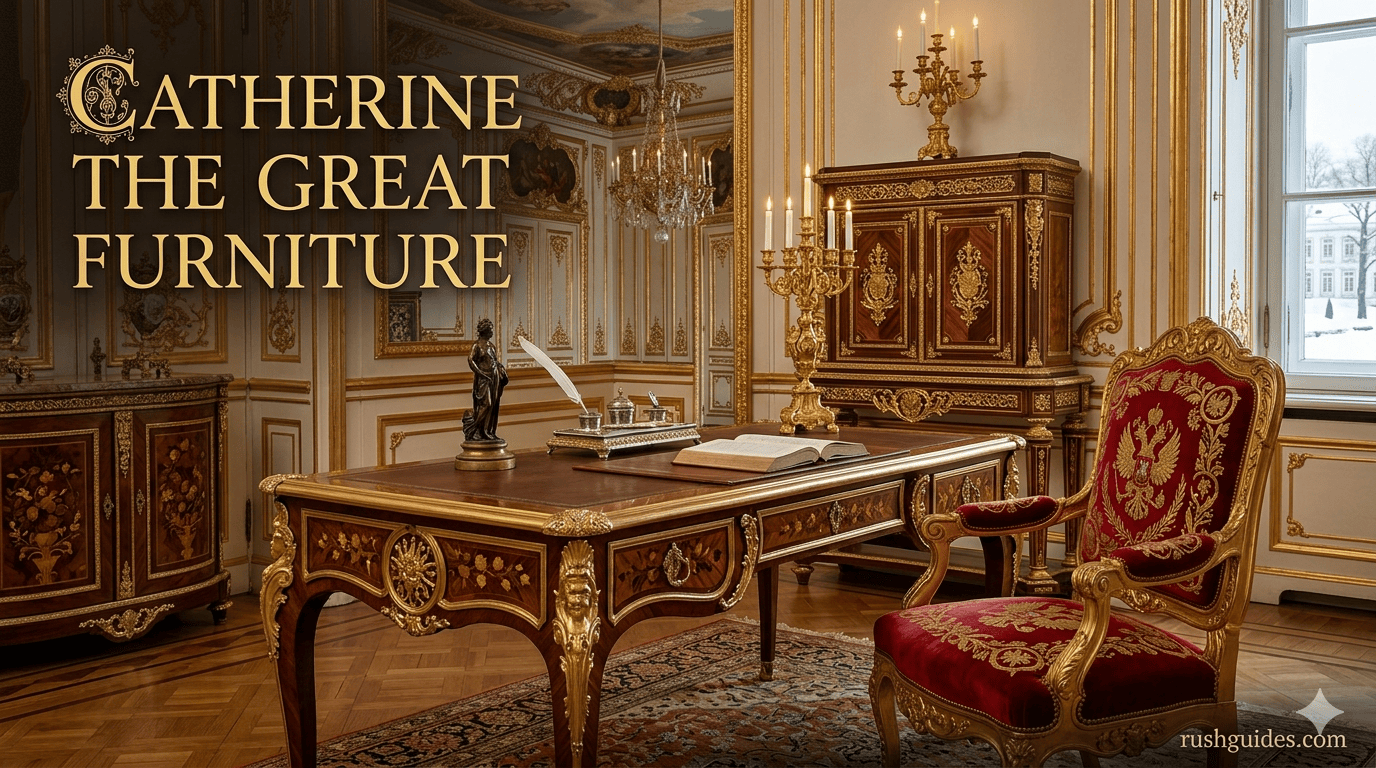
Few rulers in history collected furniture the way Catherine the Great did not as decoration, but as a statement. As Empress of Russia from 1762 to 1796, Catherine II commissioned and collected extraordinary furniture that blended European elegance with Russian opulence, using each piece as a powerful symbol of political authority and cultural sophistication. She wasn’t just buying chairs. She was building an image.
And one part of that image the erotic furniture legend has followed her name for centuries.
This article covers the full picture: the real pieces, the real craftsmen, the palaces that housed them, and the myth that refuses to die. Whether you’re a design enthusiast, a history nerd, or someone who stumbled onto a very curious corner of the internet, this is the definitive guide to Catherine the Great’s furniture.
The Historical Context That Made It All Possible
Catherine wasn’t Russian by birth. Born in Prussia as Sophie of Anhalt-Zerbst, she married into the Romanov dynasty at age 16 and eventually seized power through a palace coup in 1762. What followed was one of the most ambitious cultural reinventions a monarch had ever attempted.
Her reign is regarded by many as the Russian Empire’s Golden Age because of its substantial geographical growth, governmental changes, and cultural advancements. She modelled herself as an Enlightened ruler, read Voltaire, corresponded with Diderot, and poured enormous resources into art, architecture, and interior design. Furniture wasn’t a side interest it was central to the story she was telling about Russia’s place in the world.
Much of the European Enlightenment found inspiration in Catherine, who tried to modernise Russia by borrowing and infusing Western European ideas and tastes a philosophy visible throughout her furniture collections, which drew from Rococo, Neoclassicism, and Baroque traditions.
The Styles That Defined Catherine the Great’s Furniture
Rococo: Gilded Curves and Drama
Catherine the Great’s furniture was heavily influenced by Rococo, an 18th-century artistic movement characterised by grace, rich decoration, and a general lightness of tone delicate carvings, asymmetrical patterns, and pastel hues. Early in her reign, Rococo was the dominant language of European luxury, and Catherine spoke it fluently.
Think: intricate scrollwork, floral motifs, sinuous curves, and gilt finishes on everything. These weren’t subtle rooms. The Catherine Palace at Tsarskoye Selo, her summer retreat, is the extreme example the kind of interior that makes the Palace of Versailles feel restrained.
Neoclassicism: Where Power Gets Clean Lines
As the Enlightenment deepened, Catherine pivoted toward Neoclassicism. Catherine the Great’s interior design introduced Neoclassicism to Russia, influencing palace architecture, décor, and furniture arrangement, setting new standards of harmony, sophistication, and artistic expression in royal residences.
Neoclassical furniture was more ordered than Rococo — straighter lines, symmetrical shapes, Greek and Roman motifs like urns, lyres, and laurel wreaths. It read as rational, educated, and modern. For Catherine, who wanted Russia seen as a European intellectual powerhouse, that was exactly the point.
The Master Craftsmen Behind the Collection
Catherine didn’t just buy furniture. She cultivated relationships with the best makers in Europe and essentially had them on retainer. Three names stand above the rest.
David Roentgen: The Rock Star of 18th-Century Cabinetmaking
The German furniture master David Roentgen visited St. Petersburg in 1786 and was commissioned by Catherine the Great to produce mahogany cabinets decorated with ormolu for gems and medals. That visit marked the beginning of a relationship between Catherine and Roentgen that produced some of the most technically extraordinary furniture of the century.
Roentgen’s pieces were famous not only for their beauty but for their engineering. His furniture often featured hidden compartments, secret drawers, and other mechanical marvels that delighted Catherine and her guests. His most celebrated piece for her was the Cameo Cabinet crafted by Roentgen, it housed rare cameos and featured secret compartments, symbolising Catherine’s love for both function and beauty.
One of the most famous pieces linked to her is Roentgen’s “Berlin Cabinet,” an incredibly complex marquetry and ormolu masterpiece she purchased in 1782. It’s a star exhibit at the Kunstgewerbemuseum in Berlin today.
The furniture Roentgen created for the Russian court often featured marquetry made from exotic woods like mahogany and rosewood, as well as gilded bronze mounts, mother-of-pearl inlays, and other precious materials. Think of him as the equivalent of a luxury automotive designer today technically brilliant, absurdly expensive, and completely in demand.
Jean-Henri Riesener: French Precision
Jean-Henri Riesener was the premier French furniture maker of the 18th century. He served as royal cabinet-maker to Louis XVI before working for Catherine. His pieces featured exquisite marquetry work and gilded bronze mounts the craftsmanship so fine that joints were nearly invisible. Catherine acquired several of his pieces as part of her broader mission to own the best that European workshops could produce.
The Gambs Brothers: Russia’s Own Masters
Not everything came from abroad. The Gambs brothers, based in St. Petersburg, were among the craftsmen who produced furniture for Catherine’s court adapting European styles and techniques using locally available materials. Catherine actively invested in developing Russian craftsmanship alongside her foreign acquisitions, a deliberate cultural strategy as much as an economic one.
The Materials: What Made It All So Extraordinary
Catherine’s furniture used exotic woods like mahogany, rosewood, and ebony. Decorations included gilded bronze (ormolu), precious stones like malachite and jasper, silver and gold leaf, ivory inlays, and luxurious silk velvet upholstery.
Malachite deserves a special mention. The deep green stone, mined in the Ural Mountains, became practically synonymous with Russian imperial luxury during Catherine’s reign and continued through the 19th century. Combined with ormolu fittings that distinctive gilded bronze metalwork the result was furniture that felt simultaneously weighty and luminous.
The Most Famous Pieces in Catherine the Great’s Furniture Collection
Within her vast furniture collection, certain pieces achieved legendary status for their beauty, innovation, and symbolism. Among the most famous is Catherine the Great’s throne a creation of carved wood and gold leaf, upholstered in crimson velvet and adorned with imperial emblems. It served as a visual embodiment of her rule: majestic yet measured, ornate yet structured. Positioned beneath vast chandeliers and surrounded by gilded mouldings, it was both furniture and political theatre.
Then there’s the mechanical writing desk. Created by David Roentgen, this remarkable piece was not just furniture but an engineering marvel, incorporating secret drawers, hidden mechanisms, and intricate marquetry. It’s the piece that best captures Catherine herself brilliant, layered, and full of things happening beneath the surface.
The Hermitage alone holds over 1,000 pieces of furniture from Catherine’s era, offering a window into the opulence of her court and the cultural aspirations of 18th-century Russia.
The Erotic Furniture Legend: Separating Myth from History
Here’s the story that brought a lot of you to this article. Let’s be honest about what we actually know.
The story goes that during the Nazi invasion of the Soviet Union, two Wehrmacht officers stumbled upon a collection of erotic furniture that Catherine the Great had purportedly owned in her lifetime, and snapped photos of the X-rated pieces. Historians have never found concrete evidence that these pieces belonged to the empress or even that the photographs were found by Wehrmacht officers in the first place.
According to the urban legend, the erotic cabinet was adjacent to Catherine’s suite of rooms at Gatchina Palace. Furniture allegedly featured tables with phallic legs, walls covered in erotic art, and even erotic artefacts supposedly brought from Pompeii. The rooms and furniture were allegedly seen in 1940 by two Wehrmacht officers during the Nazi invasion of the Soviet Union but even if that were true, the rooms and furniture seem to have vanished since then.
No verified photographs of Catherine’s alleged erotic furniture have surfaced. While rumours persist that soldiers took pictures of these items, those claims are not proven. Any such pieces, if they existed, would likely have been destroyed when Catherine’s palaces were bombed and burned during World War II.
Despite the persistence of the erotic furniture legend, there is no definitive proof that Catherine the Great ever commissioned such items. Many historians believe the stories are largely the result of myth-making, possibly fuelled by political enemies or jealous rivals. The most compelling argument against authenticity is that no such pieces have been found in the extensive art collections left behind by Catherine.
The context matters here. Such claims were often used to demonise Catherine and her liberal sexuality. She was a woman who wielded enormous power in an era when men controlled it almost entirely. Rumours about erotic rooms were a very effective way of delegitimising her then and, apparently, for several centuries after.
The photographed pieces, if real, were later recreated by a French furniture maker in colour to preserve their memory which means what circulates online today is reconstruction, not documentation. That’s an important distinction.
The erotic furniture story is fascinating. It’s also almost certainly more legend than fact. What it tells us most clearly is how powerful people particularly powerful women get remembered when their enemies get to shape the narrative.
Where to See Catherine the Great’s Furniture Today
You don’t need to take anyone’s word for the quality of these pieces. You can see them yourself.
The State Hermitage Museum in St. Petersburg is the single best place on Earth to experience Catherine the Great’s furniture in its original context. Entire rooms are furnished exactly as they were in her day.
You can also see her furniture at the Catherine Palace at Tsarskoye Selo and Pavlovsk Palace, which house the largest collections of original pieces and accurate reproductions.
Occasionally, pieces attributed to Catherine appear at Sotheby’s and Christie’s auctions, fetching high prices. As of mid-2026, authentic Catherine the Great furniture is considered priceless and rarely sold — when period pieces do appear at auction, they command hundreds of thousands to millions of dollars.
If you’re a collector hunting for something in her style, focus on authenticated 18th-century Russian-European pieces with documented palace provenance. Look for inventory marks from imperial palaces, hand-cut dovetails rather than machine-made joinery, and the distinctive darker grain of Siberian mahogany.
Catherine’s Lasting Influence on Design
The influence of Catherine the Great’s furniture can still be seen in modern design. The emphasis on craftsmanship, the fusion of different styles, and the use of luxurious materials continue to inspire contemporary furniture makers and designers.
She essentially forced Russian design to grow up fast. By demanding the best from European workshops while simultaneously investing in local craftsmen, she created a distinctly Russian-European aesthetic heavier than French originals, more lavishly decorated, but technically sophisticated in its own right. Luxury furniture houses still reference that tradition today.
Her collection also changed what furniture meant culturally. Pieces weren’t just functional objects. They were biography, politics, and ambition expressed in wood, gilt, and stone. That idea that the objects around you say something real about who you are is one that’s never really gone away.
FAQ
Is Catherine the Great’s erotic furniture real?
No confirmed evidence exists. The story originates from unverified accounts of photographs allegedly taken by German soldiers in 1940. No pieces have ever been found or authenticated, and most historians treat the legend with significant scepticism.
Where is Catherine the Great’s furniture collection held?
The largest collection is at the State Hermitage Museum in St. Petersburg. Additional pieces are displayed at the Catherine Palace at Tsarskoye Selo and Pavlovsk Palace.
Who made furniture for Catherine the Great?
Her most celebrated maker was David Roentgen, a German cabinetmaker famous for mechanical furniture with hidden compartments. Jean-Henri Riesener (France) and the Gambs brothers (St. Petersburg) were also major contributors.
Can you buy Catherine the Great’s furniture?
Authentic pieces are essentially national treasures held in Russian state museums. Period pieces occasionally surface at major auction houses like Sotheby’s or Christie’s, where they sell for millions. Reproductions in the Neoclassical and Rococo styles she favoured are far more accessible.
What materials did Catherine the Great’s furniture use?
Mahogany, rosewood, and ebony were the dominant woods. Decorative elements included ormolu (gilded bronze), malachite, jasper, gold and silver leaf, ivory inlays, and silk velvet upholstery.
If you want to understand Catherine the Great, look at what she chose to sit on, write at, and surround herself with. The real furniture tells you everything about her intelligence, her ambition, and her obsession with how Russia was perceived by the wider world. The erotic furniture tells you everything about how history treats powerful women who refuse to apologise for existing on their own terms.
Read More About: Cassandra Jade Estevez