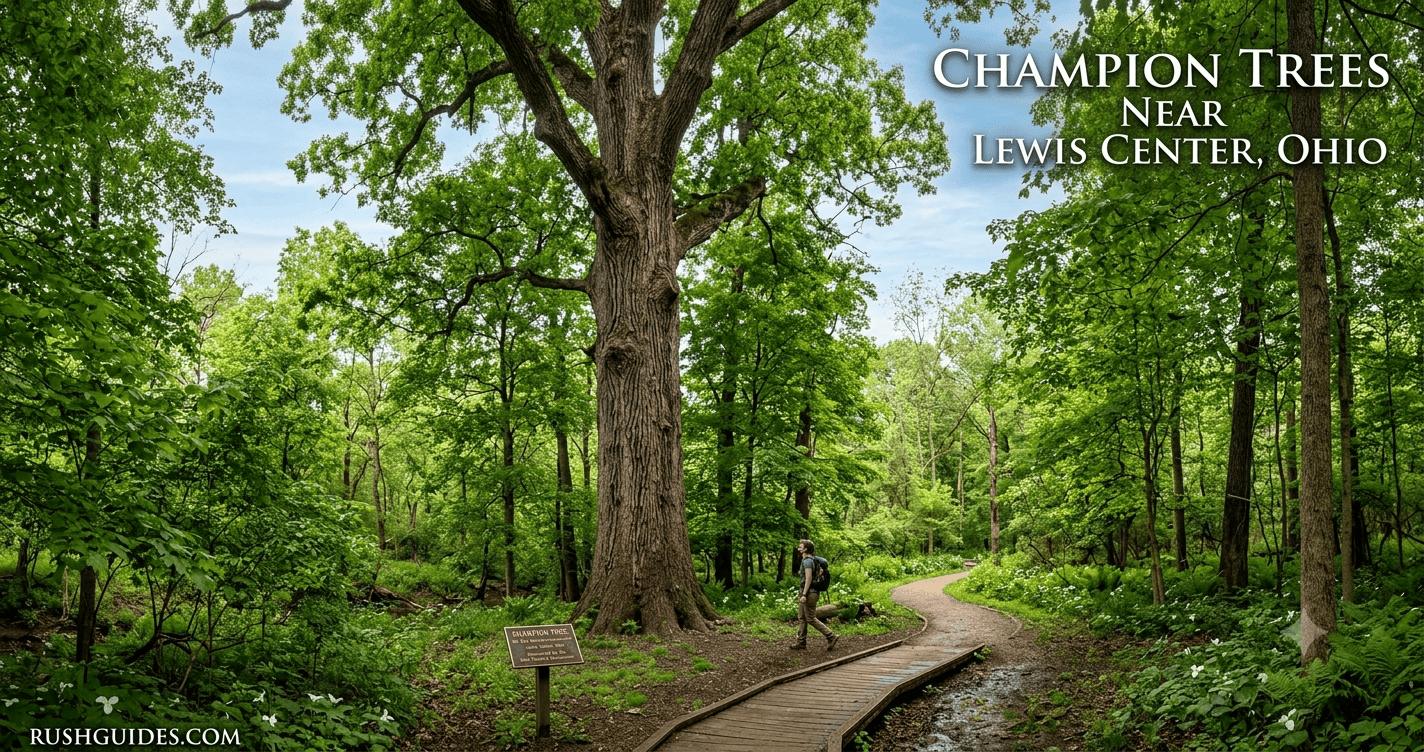
Lewis Center gets a lot of attention for its schools, its fast-growing neighborhoods, and its proximity to Columbus. What doesn’t get nearly enough attention are the absolute monsters growing in the parks and creek corridors just minutes from those new subdivisions. We’re talking about trees so large their trunks would take four people linking hands to encircle, trees that were already mature when Ohio became a state in 1803.
The champion trees near Lewis Center Ohio are the largest documented specimens of their species, officially recognized through the Ohio Department of Natural Resources (ODNR) Big Tree Program using a standardized scoring formula. Since 1940, the organization American Forests has maintained a national register of the largest known trees of each species, and Ohio runs its own program through the ODNR to track the state’s biggest specimens. These aren’t just old trees that someone got sentimental about. They earn their status through measurement, verification, and comparison with every other tree of the same species in the state.
This guide tells you exactly which trees hold records near Lewis Center, where to find them, and what makes Delaware County such an unexpectedly fertile place for record-setting hardwoods.
How Champion Trees Are Measured
Before hunting for giants, it helps to understand the system. A tree earns its points through a simple formula: Trunk Circumference (in inches) + Tree Height (in feet) + ¼ of the Average Crown Spread (in feet). Trunk circumference is always taken at 4.5 feet above the ground. The highest-scoring tree of its species in Ohio takes the champion title.
The beauty of the system is that it rewards more than just girth. A tree with a strong crown and good height can compete even if its trunk is not the thickest in the state. The title isn’t permanent either. New champions appear almost every year across Ohio, since trees once hidden in back fields or wooded edges become recognized once someone measures them.
One thing worth saying clearly: Lewis Center itself doesn’t have a confirmed official state champion growing on a city street corner. The central takeaway is that the champion-tree conversation around Lewis Center is really a Delaware County and Alum Creek story. Lewis Center is close enough to Alum Creek State Park that readers often group them together. That geographic grouping is accurate enough for practical purposes, and the trees absolutely justify the trip.
Why Delaware County Produces Champion Trees
The landscape surrounding Lewis Center owes much of its fertility to glacial activity that occurred thousands of years ago. As glaciers advanced and retreated, they deposited nutrient-rich soils across Delaware County. These deep soils allow tree roots to grow extensively, providing stability, moisture access, and long-term nourishment.
Water access matters just as much as soil. The area is close to the Olentangy River and Alum Creek. These water sources keep the soil moist. Trees near water often grow faster and larger because they never struggle for moisture.
Then there’s the fact that some of these trees simply got lucky. Although large portions of Ohio’s original forests were cleared for farming during the nineteenth century, many significant trees were spared. Some were left standing as boundary markers or shade trees, while others survived because removing them proved impractical. The shale ravines at Highbanks are a perfect example. The terrain was too steep to log efficiently, so pre-settlement trees quietly kept growing while everything around them came down.
The Biggest Champion Tree Near Lewis Center: The Alum Creek Cottonwood
When people talk about Lewis Center Ohio champion trees, one tree comes up more than any other. The Eastern Cottonwood growing inside Alum Creek State Park near the intersection of Africa Road and Cheshire Road is, by most measures, one of the most impressive trees in Ohio. This giant has been recorded at roughly 380 inches in circumference, stands over 120 feet tall, and spreads its crown nearly 103 feet across. That puts its total score above 527 points, making it Ohio’s largest cottonwood.
At various points in recent history, it has also held recognition as a national co-champion contender, meaning it ranked among the largest of its species in the entire United States.
Getting there is straightforward. Visitors can reach this tree by parking near the marina at Alum Creek State Park and following the Cheshire Loop trail. In spring, the ground around it is often covered in cottony seed clusters. In summer, the canopy creates a massive circle of shade that feels like standing inside a natural cathedral.
Notable Champion Trees in the Delaware County Area
White Oaks
White oaks are among the most respected trees in Ohio’s hardwood forests, and the Lewis Center area has produced some genuinely outstanding specimens. These trees grow slowly, sometimes adding only a few inches in diameter over a decade, but that slow growth produces incredibly dense and durable wood that can hold up for centuries. Several white oaks in and around Lewis Center have trunk circumferences exceeding 200 inches. Some of these trees are estimated to be more than 200 years old, meaning they were already mature when Ohio became a state in 1803.
White oaks are especially common in Highbanks Metro Park and along preserved corridors near the Olentangy River. Their wide, spreading crowns are easy to recognize, and their thick furrowed bark gives them a look of permanence that few other trees can match.
The Champion Black Walnut
Another tree that brings Delaware County into Ohio’s big tree conversation is a champion Black Walnut located on private land near Lewis Center. This tree has been measured at approximately 211 inches in circumference, stands around 103 feet tall, and carries a crown spread of over 102 feet, adding up to about 340 total points. It’s not publicly accessible, but its existence tells you something about how good the growing conditions are in this part of Ohio.
The Pawpaw State Champion
Not every champion tree is a colossus. The Pawpaw growing in the Lewis Center area holds the Ohio state champion title for its species despite being a much smaller understory tree. It measures roughly 54 inches in circumference and stands about 23 feet tall. Pawpaws are native to Ohio and produce custard-like fruits each fall. They tend to grow in clusters along creek bottoms and shaded floodplains, forming dense groves that support a variety of wildlife.
American Sycamores
Highbanks Metro Park features two large sycamores that are reportedly 500 years old, with circumferences of 23 to 24 feet. That’s over 276 inches in circumference for a single trunk. Some sycamore specimens in the Alum Creek and Olentangy corridor have trunks so wide that a group of four adults linking hands could not fully encircle them.
Where to Go: Best Parks for Big Tree Hunting Near Lewis Center
Highbanks Metro Park
Highbanks is named for its massive 100-foot-high shale bluff towering over the Olentangy State Scenic River. It’s also the closest major natural area to Lewis Center’s central neighborhoods. The park covers over 1,100 acres along the Olentangy River and features deep shale ravines that provide a natural microclimate for tree growth.
For tree hunters specifically, three trails stand out:
The Dripping Rock Trail runs along the Olentangy River bluffs and offers excellent views of large sycamores and cottonwoods near the water. The Beech Ridge Trail passes through mature beech and oak forest, with several large specimens visible from the path. The Big Meadows Loop offers a mix of open space and woodland edges, with older trees marking the transitions.
Metro Parks also says forests in Highbanks are recognized by the Old Growth Forest Network, making Highbanks especially relevant for anyone looking for older forest structure.
Address: 9466 Columbus Pike (US Route 23 North), Lewis Center, Ohio 43035
Alum Creek State Park
Home of the record-breaking Eastern Cottonwood described above. The park encompasses over 3,000 acres and includes the 3,387-acre Alum Creek Reservoir. The floodplain areas near the creek and reservoir are prime habitat for Eastern Cottonwood, one of the fastest-growing and potentially largest trees in Ohio.
The northern reaches of the park in Delaware County contain significant stands of mature hardwood timber. Go past the reservoir activity and into the quieter wooded sections near the waterways for the best tree encounters.
Char-Mar Ridge Park
Char-Mar Ridge Park, located directly on Lewis Center Road, is the most convenient stop. Its 128 acres of mature ravine forest are home to the classic Ohio hardwood mix of oak, beech, maple, and hickory. It’s smaller and less visited than Highbanks, which actually works in your favor if you want a quieter walk.
The Olentangy Trail
As this trail winds through Lewis Center and southern Delaware County, look toward the river for massive sycamores and cottonwoods. It’s primarily a biking and walking path, but the riparian corridor alongside it produces some of the most impressive tree growth in the area.
How to Nominate a Champion Tree
You don’t need a forestry degree to get involved. The ODNR Champion Tree Program is a voluntary conservation initiative that documents the largest trees in the state and encourages their preservation. Anyone, from foresters and landowners to curious neighbors, can nominate a tree.
The process is straightforward:
Photograph the tree from multiple angles. Measure circumference at 4.5 feet. Estimate height using available tools. Record GPS coordinates if possible. Submit the nomination to the Ohio Champion Tree Program.
Champion trees can be anywhere, including private yards, cemeteries, golf courses, and old farmsteads. Some of the most significant undiscovered specimens in Delaware County are probably sitting in old farm woodlots where nobody has thought to look yet.
The Threat to Lewis Center’s Tree Giants
Lewis Center is one of the fastest-growing areas in Ohio. This rapid development poses a significant threat to the area’s champion trees. Soil compaction from heavy machinery, changes in water drainage patterns, and the clearing of secondary forests for housing can all stress or kill ancient trees.
A 300-year-old bur oak cannot be replaced within any human timescale. Some developers in the area have worked around significant trees rather than removing them, allowing a massive oak or cottonwood to become the centerpiece of a subdivision’s green space. Those decisions matter more than they might seem at the moment.
On April 10, 2026, the ODNR announced the first major distribution of seedlings from the Buckeye State Tree Nursery, a project specifically designed to propagate the genetics of existing giants, ensuring the next generation of Ohio forests retains the same potential for monumental growth.
FAQ: Champion Trees Near Lewis Center Ohio
What is the largest champion tree near Lewis Center?
The Eastern Cottonwood at Alum Creek State Park holds that distinction. It measures approximately 380 inches in circumference, stands over 120 feet tall, and has a crown spread approaching 103 feet, producing a total score above 527 points. It has ranked as a national co-champion contender among all cottonwood trees in the United States.
Are the champion trees on public land?
Some are, some aren’t. The Alum Creek cottonwood and Highbanks sycamores are publicly accessible. The champion black walnut near Lewis Center sits on private land. Always stay on marked trails and respect private property.
Can the champion title change?
Yes, frequently. The new tree takes the title when a larger specimen is found and verified. The previous champion is still celebrated and recorded, but the registry is updated to reflect the new record-holder. Titles can change whenever a larger specimen is discovered.
How old are the champion trees near Lewis Center?
Some white oaks in the undisturbed ravines of Highbanks are estimated to be between 300 and 450 years old. The reported 500-year-old sycamores at Highbanks would put their origin around the early 1500s, well before European settlement of Ohio.
Does champion status protect a tree legally?
Champion status alone doesn’t guarantee legal protection. Many champion trees sit on protected public land, but private landowners are encouraged, not required, to preserve them.
Standing under one of these trees changes your perspective on Lewis Center in a way that no amount of reading about it can. The area’s reputation for new construction and good schools is real, but so is this quieter story written in wood and bark over centuries. Alum Creek and Highbanks are both open year-round, so there’s no excuse to keep putting off the visit. Go on a weekday morning when the trails are quiet, bring a flexible tape measure, and look up more than you think you need to.
Read More About: Cevurı