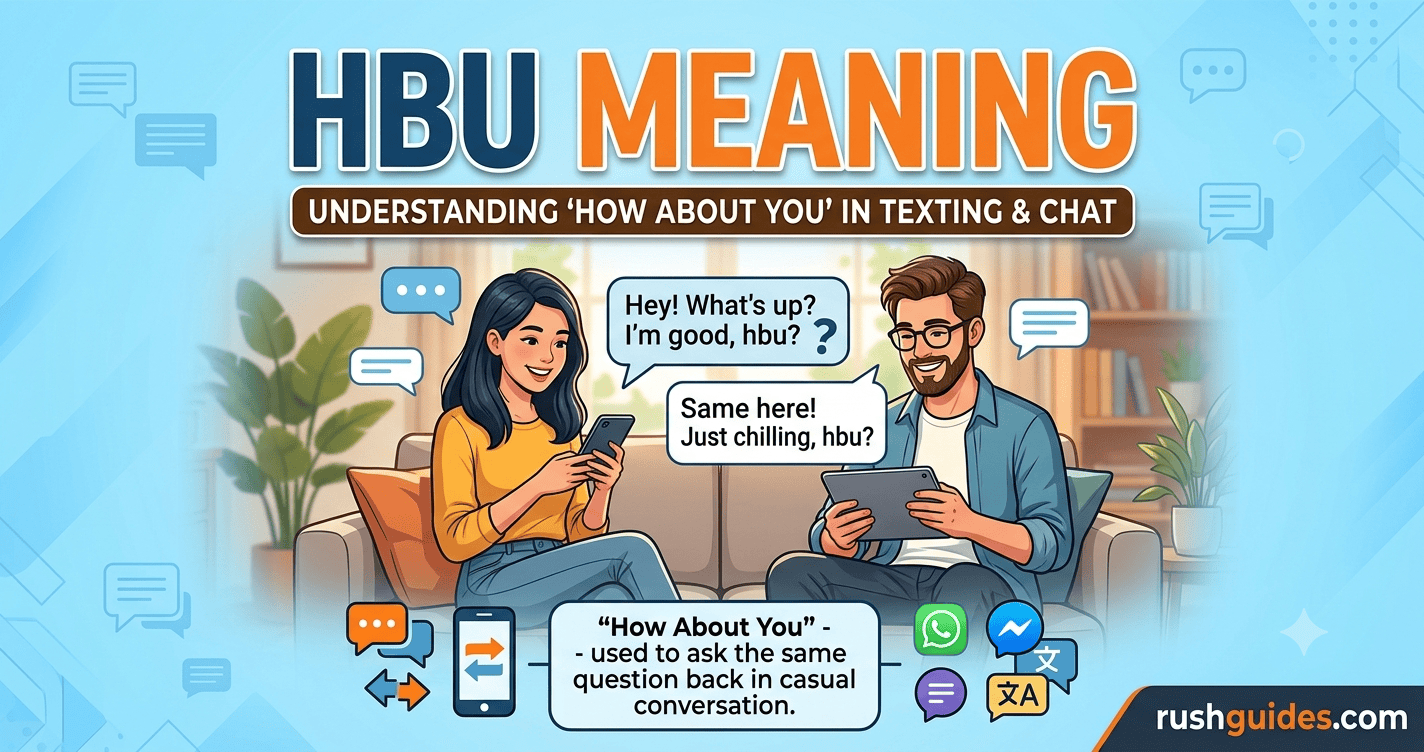
HBU stands for “how about you.” That’s it. No hidden meaning, no inside joke you missed. It’s a shortcut people type when they want to bounce a question back at someone without retyping the whole sentence.
What Does HBU Mean in Text
The core hbu meaning in text is “how about you,” used as a quick way to return a question. Someone asks how you’re doing, you answer, then you tack on “hbu” instead of writing out “how about you” again.
A typical exchange looks like this:
Person A: How’s your week going?
Person B: Pretty good, just busy with work. hbu?
That last line does the job of a full sentence in three letters. According to How-To Geek, HBU is expressed in both lowercase and uppercase, though people write it in lowercase far more often since chatting doesn’t usually call for careful capitalization.
You’ll see hbu used well beyond the classic “how are you” exchange too. People drop it after sharing an opinion, a weekend plan, or a piece of news, basically anytime they want the other person to weigh in with their own version of the same thing. AddictiveTips notes that hbu shows up naturally in Instagram DMs, dating app small talk, and gaming chats between matches, not just in old school text messages.
Where HBU Came From
HBU didn’t appear out of nowhere. It grew out of the same instant messaging culture that gave us LOL, BRB, and TTYL. Back when AOL Instant Messenger and early flip phone texting made every character count, people started chopping full phrases down to their initials so conversations could move faster.
“How about you” was a natural target for that treatment. It’s a phrase people type constantly in casual chat, so shrinking it to four letters saves real time once you add up hundreds of messages a day. As smartphones took over and texting became the default way people talk to friends and partners, hbu just kept riding along.
Linguist David Crystal has argued that abbreviations like this aren’t a sign of sloppy language, they’re closer to a separate register people use on purpose for informal writing, the same way you’d talk differently at a dinner party than you would with your college roommate.
HBU vs WBU: Is There Really a Difference
If you text a lot, you’ve probably seen WBU pop up too. WBU stands for “what about you,” and in practice it means almost the same thing as hbu. Both are used to throw a question back at someone after you’ve answered it yourself.
The small difference comes down to phrasing rather than meaning. “How about you” and “what about you” are both natural things people say out loud, and hbu and wbu just mirror whichever version someone happens to prefer. Some people default to one over the other out of habit, and neither comes across as more casual or more polite than the other. If someone texts you wbu instead of hbu, you can read it exactly the same way.
How to Use HBU in a Sentence
Here’s the pattern that almost every use of hbu follows: you answer a question or share something about yourself, then add hbu to ask the same thing back.
| Situation | Example |
| Checking in | “I’m good, just tired. hbu?” |
| Sharing an opinion | “I loved that new show. hbu, have you started it?” |
| Weekend plans | “Staying in tonight, need the rest. hbu, doing anything fun?” |
| Group chat | “Down for pizza tonight, hbu guys?” |
| Dating app small talk | “I’m more of a coffee person than a tea person. hbu?” |
Notice that last group chat example. When you’re addressing more than one person, it’s common to add a plural word after hbu, like “hbu guys” or “hbu everyone,” since “hbu” on its own reads as a question to a single person.
One thing worth remembering: hbu almost never opens a conversation on its own. It works as a reply, tacked onto something you just said, not as a standalone first message.
When You Shouldn’t Use HBU
HBU is built for low stakes, casual back and forth. That makes it a poor fit for a few situations.
Skip it in professional emails or messages to your boss, a client, or a professor. “How about you” spelled out reads as basic courtesy in those settings, while hbu can come across as too relaxed for the context.
Skip it when someone shares something heavy. If a friend texts that they lost a job, are going through a breakup, or are dealing with a health scare, replying with “that’s rough, hbu?” can land as dismissive even if that’s not what you meant. A fuller response shows you’re actually paying attention.
Skip it if you’re already using it every single message. Repeating hbu after every exchange starts to feel like a script rather than a real conversation. Mixing in a genuine follow up question now and then keeps things feeling like an actual chat between two people.
Frequently Asked Questions
What does hbu mean in a text message?
It means “how about you.” People use it to ask the other person the same question they were just asked, without retyping the full phrase.
Is hbu the same as wbu?
They mean the same thing. WBU stands for “what about you” and hbu stands for “how about you.” Both are used the same way, as a quick question thrown back at someone.
Can hbu have any other meaning?
In texting, hbu almost always means “how about you.” There isn’t a common alternate meaning you need to worry about mixing up.
Is it rude to use hbu?
Not on its own. It’s friendly and casual in most day to day texting. It only feels off in professional messages or in response to something serious, where a fuller sentence fits better.
Should hbu be capitalized?
Either works. Lowercase (hbu) is more common in casual texting since people rarely bother capitalizing while chatting quickly, but HBU in caps is understood exactly the same way.
Next time hbu shows up in your messages, you’ll know exactly what it means and how to answer without missing a beat. It’s a small shortcut, but it does a real job: keeping a conversation feeling like a two way street instead of an interview.
Read More About: Hazel Moder