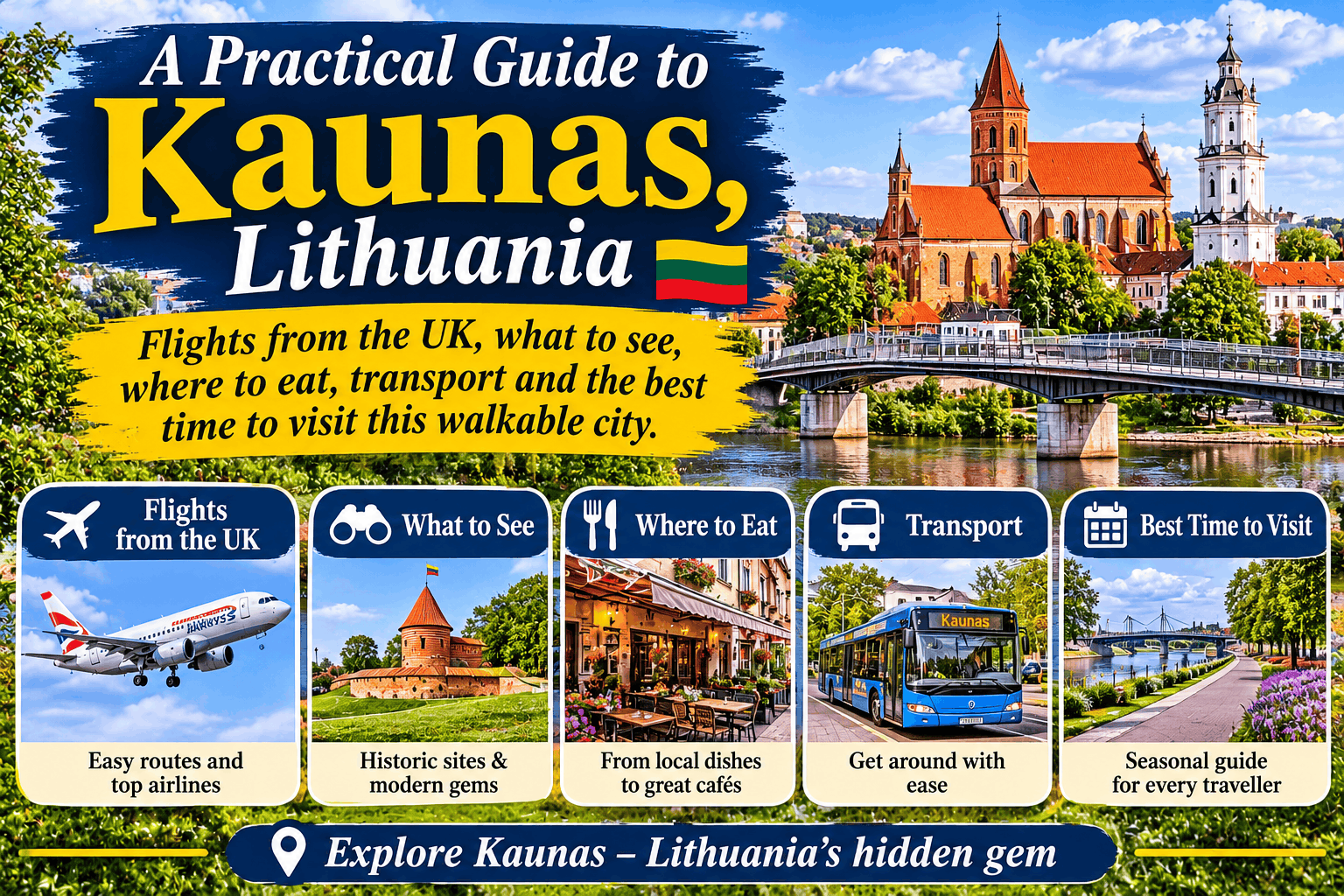
Kaunas is Lithuania’s second-largest city, and it is increasingly being talked about as a destination in its own right rather than a stopover on the way to Vilnius . It is a compact, walkable city with a striking mix of interwar modernism, medieval Old Town charm, a quirky Devils’ Museum, and a food scene that now includes six restaurants in the Michelin Guide Lithuania 2026 . The most practical thing to know is that Kaunas is easy to reach from the UK, with direct Ryanair flights from London Luton and Stansted taking around 2 hours 35 minutes to 2 hours 40 minutes, with fares that have been listed from as low as £19.99 one way . This guide covers what to see, where to eat, how to get around, and the practical details for a visit.
Getting There and Getting Around
Kaunas Airport is about 13 to 17 kilometres from the city centre. The 29G airport bus is the main public transport option, taking around 30 to 40 minutes to reach central stops. A taxi or ride-hail typically takes 18 to 22 minutes in normal traffic .
Within the city, the centre and Old Town are quite walkable. There is a practical bus and trolleybus network, and visitors can use the Trafi app for live routes, buy tickets in the Žiogas app, or pay on board with contactless bank cards . Since January 2026, ticket prices purchased from the driver increased to €1.50, while tickets bought through the Žiogas app or card remained unchanged. Passengers without a valid ticket can now pay an €8 “control fee” to continue their journey .
What to See: The Essential Kaunas
The city’s attractions are clustered, which makes it easy to cover a lot on foot.
Old Town and Laisvės Alėja
Kaunas Castle is the starting point for most visits, a 14th-century Gothic structure near the confluence of the Neris and Nemunas rivers . From there, Town Hall Square (nicknamed “The White Swan”) is a short walk, with its baroque town hall mixing Gothic, Baroque and Classicist styles . Vilnius Street is described as the most central and beautiful street in the Old Town .
Laisvės Alėja (Liberty Avenue) is the main pedestrian boulevard, stretching 1.6 kilometres and claimed to be the longest pedestrian street in Eastern Europe . It is lined with cafés, shops and the blue and white Church of St Michael the Archangel at its eastern end .
The Funiculars and the View
Kaunas has two historic funiculars. The Žaliakalnis Funicular, dating from 1931, is the oldest functioning one in the city. It takes you up to the Church of Christ’s Resurrection, where you can climb to the rooftop lookout for panoramic views . The Aleksotas Funicular, built in 1935, whisks you from the Neris riverbank up to a hilltop viewpoint in about 30 seconds, offering a panorama of the Old Town and the river confluence .
Museums Worth Your Time
Vytautas the Great War Museum is recommended by visitors, with entry at €5. It covers Lithuanian military history across several periods, and you can climb the tower for city views, though it involves 100+ steps and two wooden ladders .
The Devils’ Museum has more than 3,000 devils from around 70 countries, and it is closed on Mondays .
Ninth Fort is a sobering memorial and museum outside the centre, requiring a taxi or car. It is an essential visit for understanding Lithuania’s difficult 20th-century history .
- K. Čiurlionis National Art Museum houses modern exhibits and is a good option for art lovers .
Pažaislis Monastery
A little further out, Pažaislis is the largest monastery complex in Lithuania and the most magnificent example of Italian Baroque architecture in the country .
Where to Eat and Drink: A Food City
Kaunas has a food scene that rewards exploration, from nostalgic Soviet-era cafés to Michelin-recognised restaurants.
Spurginė is a legendary doughnut café that has remained remarkably untouched since the 1980s, with varnished wooden interiors and waitresses who have served customers since the Soviet era. A coffee and doughnut still cost around €3 .
Višta puode serves true Lithuanian food, including a signature chicken Astra steak prepared according to a 1971 recipe for €19.90 .
Monte Pacis, one of the Michelin-recognised restaurants, is housed within a 17th-century monastery overlooking the Kaunas Lagoon. Its standout starter pairs organic roe deer tartare with crisp wheat baskets and snail caviar .
Bernelių užeiga in the Old Town is a renowned chain offering authentic Lithuanian dishes like cepelinai (potato dumplings) and šaltibarščiai (chilled beetroot soup) in a rustic interior .
Genys Brewing Co. is one of the driving forces behind the city’s craft beer scene, with experimental brews and shareable snacks .
The Castle Farmer’s Market runs every Saturday morning beside Kaunas Castle, with seasonal berries, smoked meats, farmhouse cheeses and vegetables .
When to Visit
July is the best month for warm and sunny weather, with maximum daytime temperatures averaging around 72°F (22°C) and 8 hours or more of daily sunshine . Summer generally runs from June to August with average temperatures of 17.6 to 20.2°C .
Kaunas has a busy events calendar. In 2026, the UEFA Futsal EURO took place at Žalgiris Arena in January and February . Kaunas Jazz fills the city in April, the Long Night of Museums and Kaunas City Birthday are in May, and the city hosts various cultural events throughout the year .
Frequently Asked Questions
How do I get to Kaunas from the UK?
Ryanair operates direct flights from London Luton and London Stansted to Kaunas. Flight time is around 2 hours 35 minutes to 2 hours 40 minutes, with fares listed from £19.99 one way .
How do I get from Kaunas Airport to the city centre?
The 29G airport bus takes around 30 to 40 minutes to central stops. A taxi or ride-hail takes around 18 to 22 minutes .
What is Kaunas famous for?
Kaunas is known for its interwar modernist architecture (it was Lithuania’s temporary capital between the wars), the Ninth Fort memorial, the Devils’ Museum, its funiculars, and a growing food scene with Michelin recognition .
Is Kaunas worth visiting?
Yes. It is compact, walkable, and has a distinct character that differs from Vilnius. The mix of history, quirky museums, and excellent affordable food makes it a rewarding destination for a weekend or longer .
What is the best time to visit Kaunas?
July is the best month for warm, sunny weather, with average highs around 22°C and long sunshine hours . Summer generally offers the most reliable weather for exploring.