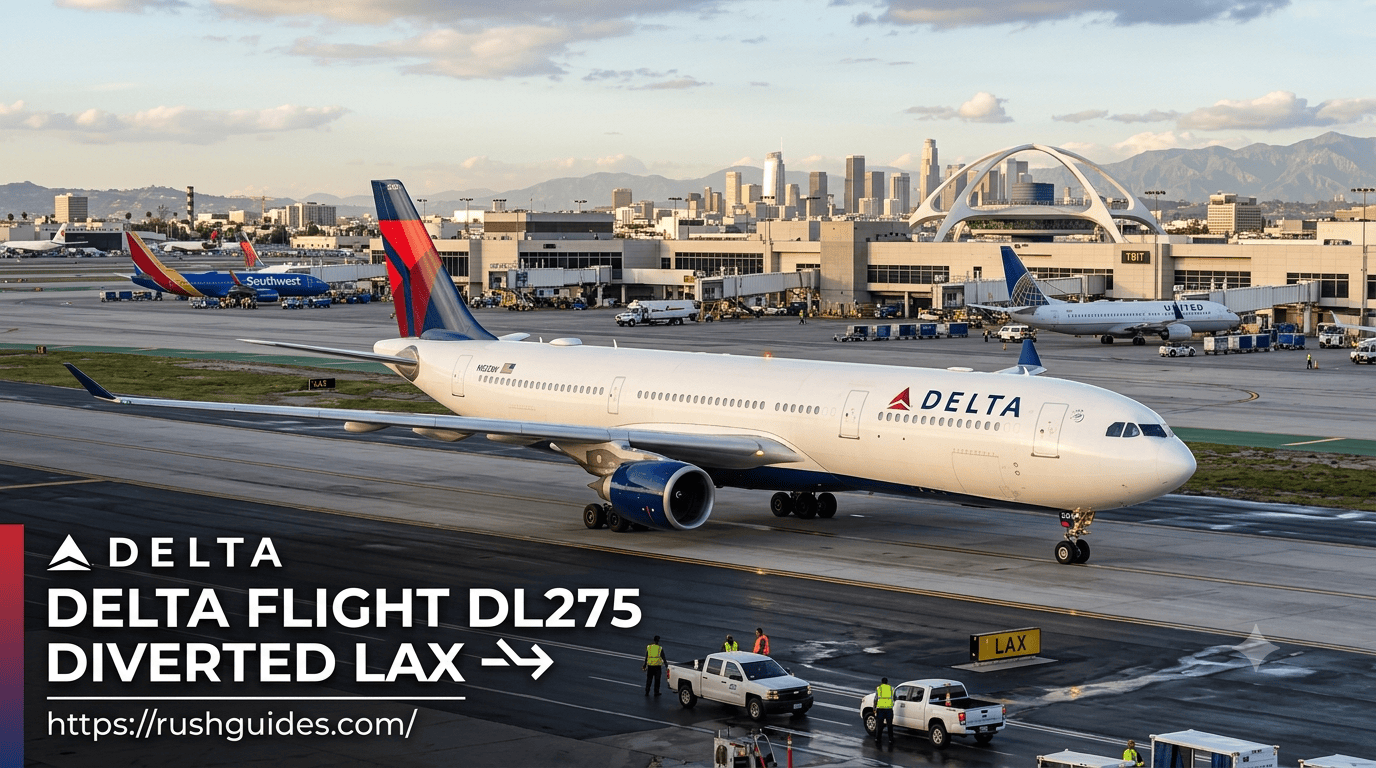
A Detroit-to-Tokyo flight that turned around mid-Pacific, flew five more hours in the opposite direction, and landed in Los Angeles in the early hours of the morning. That’s the short version of what happened to Delta flight DL275 Diverted LAX on May 27 to 28, 2025. The longer version is actually a story about modern aviation doing exactly what it’s designed to do quietly and without fanfare while nearly 300 passengers sat in the dark wondering why their Japan trip had suddenly become a California layover.
DL275 departed Detroit Metropolitan Wayne County Airport from Gate A46 on May 27, 2025, heading for Tokyo Haneda Airport on what was supposed to be a standard 13-hour trans-Pacific flight. The departure was already running roughly 45 minutes behind schedule due to a late inbound aircraft from Amsterdam. No one on board had any reason to think the next time they’d touch ground, it would be in Los Angeles.
What Triggered the Delta Flight DL275 Diversion to LAX
About five to six hours into the flight, cockpit warnings fired. The crew detected an engine anti-ice system fault over the Bering Sea, approximately 620 nautical miles southwest of Anchorage, Alaska.
The anti-ice system itself is worth understanding. An engine anti-ice system prevents ice from forming on the engine inlet through the large circular opening at the front of the engine — by routing hot compressed air from the engine itself around the inlet surface. At high altitude over cold ocean water, the risk of ice ingestion is significant enough that airlines treat any doubt about the anti-ice system’s status as a hard stop.
Without a fully functioning anti-ice system, the aircraft could face risks including engine power loss or damage from ice accumulation. With Tokyo still roughly eight hours away over some of the most remote ocean on Earth, that wasn’t a gamble the crew was willing to take.
Under FAA Extended-range Twin-engine Operations Performance Standards (ETOPS), both engines of a twin-engine aircraft operating transoceanic routes must have fully functional ice protection systems, making the anti-ice malfunction a regulatory trigger for mandatory diversion rather than a discretionary crew decision. The pilots didn’t just choose to turn around. Regulations required it.
The Aircraft: Airbus A350-900, Registration N508DN
The aircraft assigned to DL275 was an Airbus A350-900 bearing the registration N508DN, powered by two Rolls-Royce Trent XWB engines. This is one of the most capable long-haul jets in commercial service anywhere in the world, built specifically for routes like Detroit to Tokyo.
The Airbus A350-900 holds ETOPS-370 certification, meaning it can legally operate routes where the nearest diversion airport is up to 370 minutes away on a single engine. This certification doesn’t come automatically; it requires years of in-service data and demonstrated reliability rates.
The fault wasn’t an engine failure. The Rolls-Royce Trent XWB’s FADEC system, a digital engine control unit, flagged the anomaly in the anti-ice system before it could develop into anything more serious. The system caught the problem early. That’s exactly what it was designed to do.
Why LAX and Not Anchorage?
This is the part of the story that trips most people up. Anchorage was geographically closer to where DL275 was flying when the alert triggered. So why did the crew fly five more hours to Los Angeles?
The anti-ice system fault in cold weather was the critical factor. Landing in Anchorage where May temperatures can hover just above freezing and where icing conditions persist would have been the wrong choice given the specific nature of the malfunction.
Under Delta’s ETOPS operational planning for this route, LAX was the pre-designated primary diversion airport. LAX is a Delta hub with Airbus A350 maintenance certification, Rolls-Royce Trent XWB-qualified technicians, and full passenger rebooking infrastructure.
LAX also has Rolls-Royce engine specialists available 24 hours a day. The airport could help 287 passengers with customs, immigration, hotel bookings, and rebooking flights all at once. Anchorage, for all its value as a Pacific diversion hub, doesn’t offer that combination at scale.
The crew wasn’t improvising. They were following a pre-approved diversion plan, selecting the optimal airport from a vetted list.
The Full Timeline of DL275’s Diversion
Here’s how it unfolded:
May 27, 2025, afternoon: DL275 pushes back from Detroit Gate A46 with a slight delay due to a late inbound aircraft. The aircraft climbs to 38,000 feet and heads northwest toward Japan. Five to six hours into the flight, cockpit warning triggers over the Bering Sea. The captain consults technical support and declares a diversion to LAX. The cabin crew begins informing passengers calmly. Air traffic control is notified and a priority landing corridor is arranged. The aircraft turns around and flies southeast for five hours.
DL275 landed safely at Los Angeles International Airport around 1:08 to 1:38 AM PDT on May 28, touching down on runway 06R. The aircraft remained on the ground for approximately 18.5 hours for inspection and repairs.
What Passengers Experienced
As news broke about the diversion, passenger reactions varied widely. Many took to social media platforms to share their experiences in real-time. The mix of an unexpected landing with concern about missed connections created a whirlwind of emotions. Some passengers expressed frustration over the sudden change, with tweets and posts reflecting anxiety about missed business meetings in Tokyo.
Social media was also full of passengers praising the crew for keeping everyone informed throughout. Food service continued and the crew remained professional despite the stress.
On the compensation side, the rules are fairly clear even if airlines don’t always volunteer that information up front. Delta arranged alternative flights for all passengers. Under US DOT rules, financial compensation beyond rebooking is generally limited for safety diversions, but hotels, meals, and rebooking assistance are covered obligations.
Of the 287 passengers, 156 were rebooked on the next DL275 departure, 98 on Delta Flight DL295, and 33 placed on partner carriers.
Aviation cost analysts estimated the total operational impact of the DL275 diversion at approximately $5.9 million, including extra fuel burn for the 12-hour-15-minute diverted flight, maintenance inspection at LAX, passenger hotel accommodations, meal vouchers, and rebooking costs.
What Made This Diversion Unusual
Trans-Pacific diversions get attention precisely because they’re rare. The global commercial diversion rate sits between 1 and 3 percent, and Pacific route diversions are significantly lower due to strict ETOPS pre-departure screening. What makes DL275 unusual is the five-hour return flight to reach its diversion airport, far longer than typical Pacific diversions, which usually divert into Anchorage within one to two hours.
The choice to bypass closer options and fly to Los Angeles with a known system fault in sub-zero conditions over open ocean, while completely legally and operationally sound, made this a standout case study in long-haul aviation decision-making.
Is DL275 Back to Normal?
As of early 2026, FlightAware tracking data confirms DL275 continues operating the Detroit Metropolitan Airport to Tokyo Haneda route on its regular schedule without further reported diversions. The specific plane involved in the May 2025 incident was repaired and put back into service shortly after the diversion.
As of late 2025, the investigation into the DL275 diversion wrapped up with no major findings beyond the initial anti-ice fault. No NTSB investigation was opened because the incident did not meet the threshold for a mandatory reportable accident. A precautionary diversion handled by the book doesn’t require one.
The Real Takeaway From DL275
Here’s the reframe that gets lost in most coverage of this incident: what happened on May 28, 2025, was not a near-miss. It was a successful outcome. The flight crew consulted their checklists, communicated with dispatch, assessed their ETOPS alternate options, and made a conservative, correct decision. The Airbus A350-900 flew safely for five additional hours to Los Angeles without incident. Nearly 300 people walked off the plane without a scratch.
That’s not a failure. That’s aviation working exactly the way it should.
If you’re on a flight that diverts, the worst thing you can do is panic and the most useful thing you can do is stay informed. Follow the crew’s instructions, ask about accommodation and rebooking as soon as you land, and document everything if you feel your rights weren’t met. The DOT’s Aviation Consumer Protection Division is the right escalation point if Delta doesn’t meet its obligations.
FAQ: Delta Flight DL275 Diverted to LAX
Why did Delta flight DL275 divert to LAX?
The flight diverted due to a malfunction in the Rolls-Royce Trent XWB engine anti-ice system. The fault was detected at 38,000 feet over the Bering Sea. Continuing to Tokyo was deemed unsafe under ETOPS regulations.
When did DL275 divert to LAX?
The flight departed Detroit on May 27, 2025 and landed at LAX at 1:38 AM local time on May 28, 2025.
Were any passengers injured?
No. Zero injuries were reported. All passengers were safely deplaned at LAX.
How many passengers were on board DL275?
There were 287 passengers on board the flight.
Is DL275 still flying the Detroit to Tokyo route?
Yes. The route continues to operate on its regular schedule as of early 2026 with no further reported diversions.
Did passengers get compensation?
Delta arranged meal vouchers, hotel accommodations, and alternative flight rebooking for all affected passengers. Financial cash compensation beyond that is not required under US DOT rules for safety-related diversions.
Read More About: Delta Fitness Authority