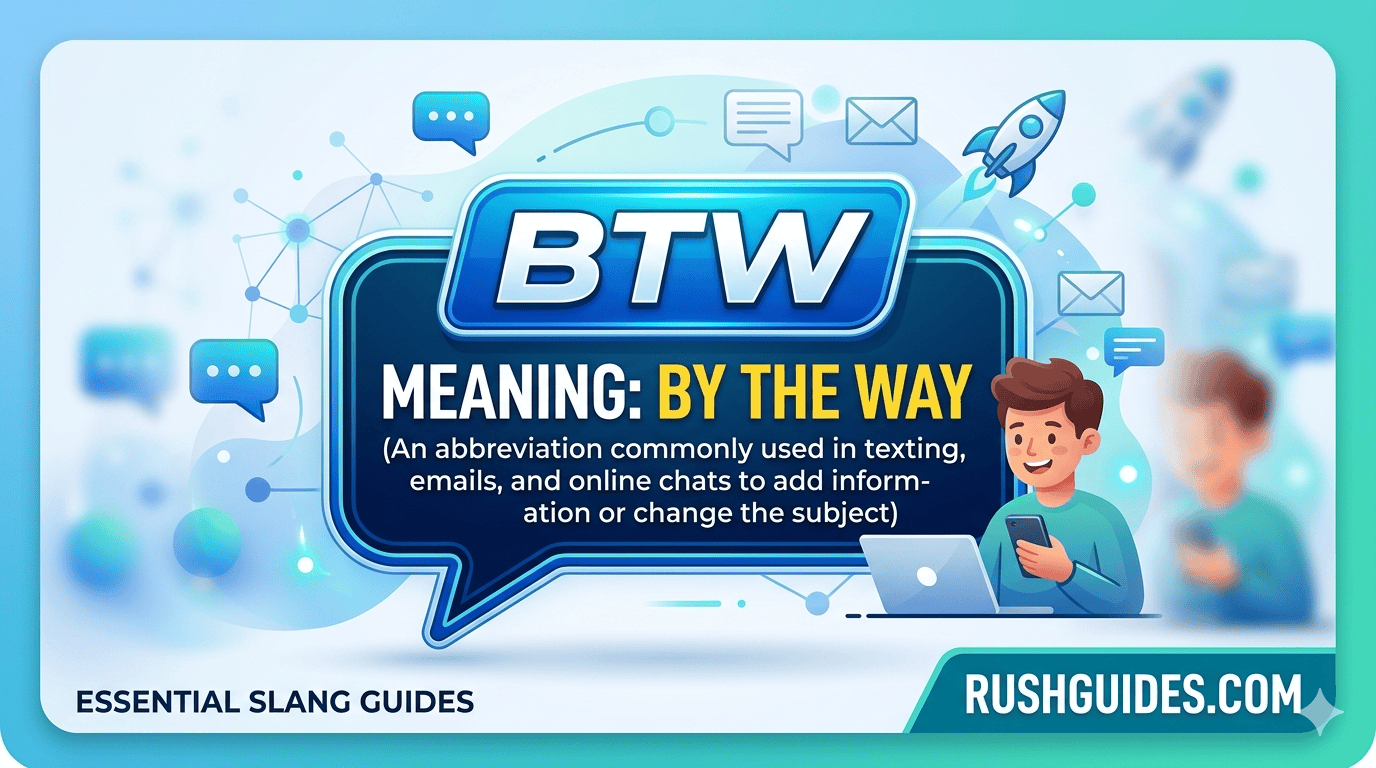
You got a message that ended with “btw” and now you’re second-guessing yourself. Don’t overthink it. BTW stands for “by the way.” It’s used to insert a new idea into a conversation, bring something up like a reminder, or quickly change the subject. That’s it. Three letters, one very common phrase.
It might look like some Gen Z invention, but BTW has actually been floating around online spaces longer than most smartphones have existed. The term originated in the 1990s, a time when internet slang and common acronyms began to flourish, and was initially used in informal written computer correspondence before becoming a staple of digital vocabulary.
If you’ve seen it in a text message, a DM, an email, or even a tweet and weren’t totally sure what was going on, this guide covers everything you need to know.
What Does BTW Mean in Texting?
BTW stands for “By the Way” and is commonly used as shorthand in written communication, such as emails and text messages. It works exactly the same way the full phrase does in spoken conversation: you’re adding a side note, slipping in something extra, or pivoting to a slightly different topic without making a big deal of it.
Think of it as the text equivalent of tapping someone on the shoulder mid-conversation to add one more thing. It’s casual, it’s quick, and it keeps things moving.
BTW appears most often at the beginning of a sentence to signal a change in direction, or at the very end to tag on a forgotten detail.
Here are a few real-world examples of how it shows up:
At the start of a message: “btw, we’re meeting at 7, not 8”
At the end: “Great seeing you last night, btw your outfit was amazing”
In the middle: “I’ll send the file over, btw it’s quite large so give it a minute”
All three are totally natural. The placement just depends on whether you’re leading with the aside or adding it on after the main point.
BTW Meaning in Text Messages vs. Formal Writing
There’s a clear line here. The full phrase “by the way” is suitable for formal writing, speeches, and professional emails where clarity and decorum are important. The acronym is strictly for casual digital contexts where speed is the priority.
So if you’re writing a cover letter or a client proposal, spell it out. If you’re texting a friend or sending a Slack message to a colleague you’re comfortable with, btw works perfectly fine.
BTW can be written in both uppercase and lowercase form, but the lowercase “btw” is much more common, especially with the rise of mobile messaging. In the early 2000s, it was common to see it written as “B.T.W.” with periods in between the letters, but that version is no longer common.
Where Did BTW Come From?
The first documented use of BTW in digital form likely occurred in the late 1980s to early 1990s, a period marked by the growing use of online bulletin board systems (BBS) and the early stages of the internet. Users of these platforms were quick to adopt acronyms as a means to save time and space, a trend further propelled by the popularity of IRC (Internet Relay Chat) and other early forms of online communication.
The phrase itself goes back even further. The phrase “by the way” can be traced back to the English language of the late 16th century, and in its earliest form was used by William Shakespeare in A Midsummer Night’s Dream (1590), where a character says “Let’s follow him, and by the way let us recount our dreams.” So the words have been around for centuries. The abbreviation just took about 400 years to catch up.
The rise of mobile texting in the early 2000s solidified BTW and similar abbreviations as essential tools in the digital communicator’s toolkit, especially on devices with limited keyboard capabilities. If you’ve ever tried typing on a T9 keypad, you understand exactly why people weren’t writing “by the way” in full.
Today, BTW is recognized globally, not just within English-speaking communities but also among non-native speakers who use English online. It shows up in tweets, WhatsApp threads, Reddit comments, Discord servers, and office Slack channels without anyone thinking twice about it.
How to Use BTW Correctly
Using BTW isn’t complicated, but there are a few things worth knowing so you don’t accidentally come across as awkward or confusing.
Use it to add a side note This is its bread and butter. You’ve said the main thing, and now you want to toss in something extra without making it the focus. “Dinner was great, btw I looked up that restaurant you mentioned and we should go.”
Use it to change the topic casually You want to shift gears without making it feel like a formal agenda item. “btw, did you see what happened on the finale last night?”
Use it to drop a reminder It softens the reminder without making it feel like a nagging follow-up. “btw, the deadline is Friday.”
Don’t confuse it with btwn A frequent misunderstanding occurs when people confuse BTW with the similar-looking text slang “btwn,” which stands for “between.” Readers might misinterpret a sentence about a location or time if they swap these meanings.
How People Actually Say It Out Loud
Written text is easy. But what happens when BTW makes it into a real conversation?
As internet slang entered mainstream vocabulary, teenagers started saying “BT Dubs” instead of spelling it out. “Dubs” is a shortened version of the letter W, and “BT Dubs” has since become fairly common in language, especially among younger people.
So if someone says “BT dubs, I heard you got the promotion” and you had no idea what they were on about, now you do. It’s the spoken version of the same three-letter shorthand.
Does BTW Have Any Other Meanings?
In almost every context you’ll encounter it, BTW means “by the way.” That’s the definition that’s been cemented into digital culture since the ’90s and confirmed by Merriam-Webster, Dictionary.com, and Urban Dictionary alike.
There are some niche alternative uses: “Beyond The Wall” in fantasy or gaming communities, “Back To Winter” used metaphorically, or “Big Time Wrestling” used by professional wrestling fans. But these are very much edge cases tied to specific communities. If someone sends you a text that just says “btw, can you call me later?” they are not talking about wrestling.
BTW is interchangeable with FYI in informal conversations, but in more formal contexts they carry different meanings. FYI is used to communicate a fact the recipient should know, while BTW is more like adding a side note and introduces a new, usually minor topic into the conversation.
BTW Across Different Platforms
The word works the same everywhere, but the vibe shifts slightly depending on where you’re using it.
Text messages: Pure casual territory. Lowercase btw at the start or end of a message is totally standard.
Instagram or TikTok comments: You’ll see it dropped in as an aside, sometimes with a slightly passive-aggressive edge. “Cute pic, btw you still owe me money” is a genre of comment unto itself.
Twitter/X: Often used to add a hot take or extra context to a main tweet. The platform’s short-form nature makes BTW a natural fit.
Emails: Fine in casual internal emails between colleagues, but worth spelling out in anything client-facing or formal.
Spoken conversation: Usually comes out as “BT dubs” rather than the full acronym, especially in younger crowds.
Related Slang You Should Know
If you’ve landed here to decode BTW, chances are there are other abbreviations in your messages that have you guessing. Here are a few that tend to pop up alongside it:
FYI (“For Your Information”) — Similar to BTW but slightly more formal and used when sharing a fact the other person should know.
IMO / IMHO (“In My Opinion” / “In My Humble Opinion”) — Used to flag that what follows is a personal take, not fact.
LMK (“Let Me Know”) — A quick way to ask someone to follow up with you.
TBH (“To Be Honest”) — Usually precedes something candid or blunt.
FWIW (“For What It’s Worth”) — Similar energy to BTW, but often used to add a perspective that may or may not change anything.
FAQ: BTW Meaning
What does btw mean in a text message? BTW means “by the way.” It’s used to add extra information, change the subject, or drop in a side note.
Is btw formal or informal? It’s informal. Use the full phrase “by the way” in professional or formal writing. Save btw for texts, DMs, and casual emails.
Can btw go at the end of a sentence? Yes. It works at the beginning, middle, or end. Putting it at the end usually signals that the detail was almost forgotten: “Great catch today, btw.”
Does btw have a different meaning in gaming? In niche gaming or fantasy communities, BTW can occasionally stand for “Beyond The Wall,” but this is rare. In general conversation, always assume it means “by the way.”
How do you say BTW out loud? Most people either say “by the way” or the informal spoken version “BT dubs,” where “dubs” replaces the letter W.
BTW is one of those abbreviations that’s been around so long it barely registers as slang anymore. Alongside being used in millions of personal messages and social media posts every day, it can also be seen in website articles, advertisements, and even professional emails. It’s genuinely everywhere, and now you know exactly what to do with it.