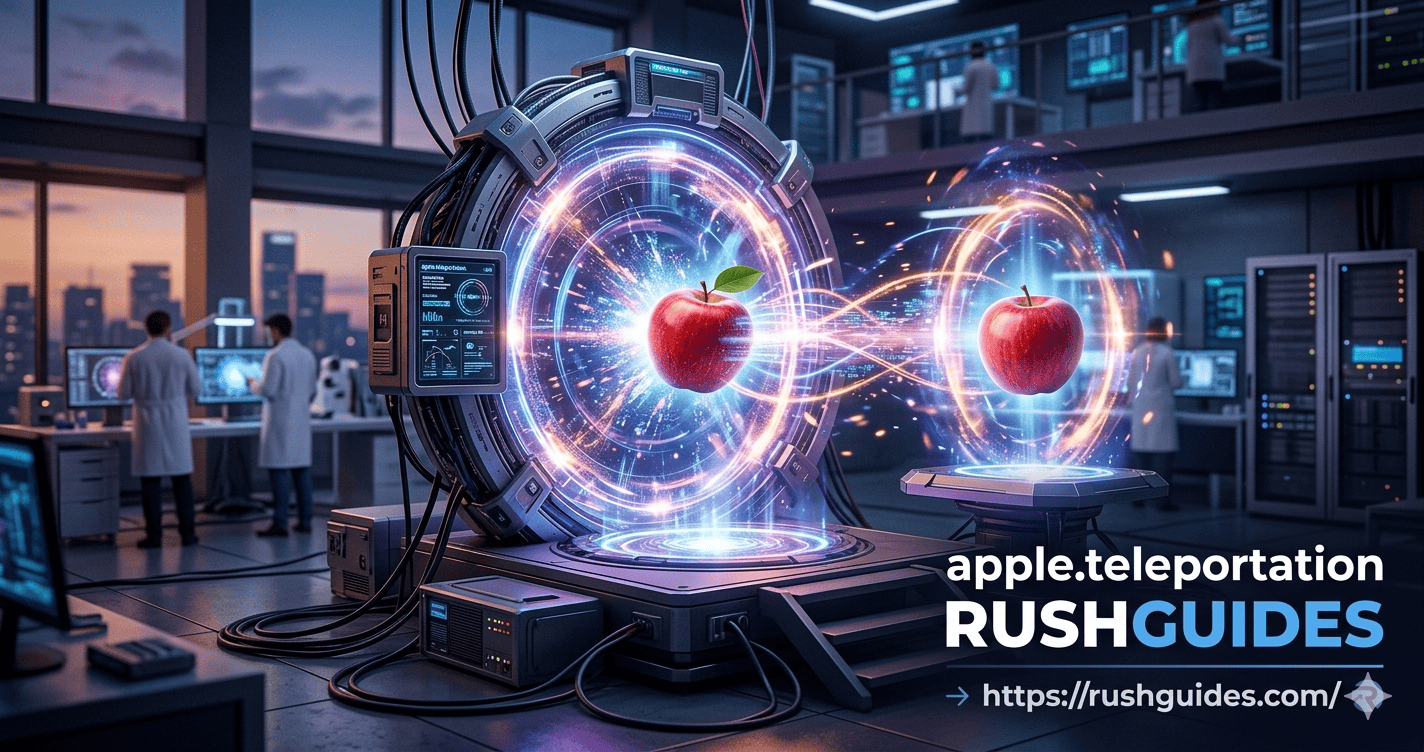
If you’ve spent more than ten minutes on TikTok or YouTube recently, you’ve probably seen the term “apple.teleportation” floating around with the kind of breathless energy usually reserved for iPhone leak season. Videos with millions of views. Supposed insiders dropping “leaked footage.” Comment sections packed with people equal parts amazed and confused.
So let’s get straight to it: Apple teleportation is not a real product. Apple has never announced, confirmed, or filed patents related to a teleportation device of any kind. No such machine is sitting on Apple Store shelves, and no credible tech journalist has verified its existence.
The “Apple Teleport” phenomenon originated from creative content on TikTok in mid-2024, where users posted videos showing instant location changes using seamless editing techniques. These clips used match cuts and transition effects available in standard video editing software, and the creators labelled their content with terms like “Apple Teleport Machine” purely to increase engagement.
That’s the short version. But the longer version is actually more interesting, because the story touches on real scientific breakthroughs, Apple’s genuine spatial computing ambitions, and the speed at which AI-generated content can turn pure fiction into something millions of people half-believe is true.
Where Did “Apple Teleportation” Come From?
As of 2026, the term “apple.teleportation” refers to a collision of three things: viral AI-generated hoaxes, real scientific breakthroughs in quantum teleportation of data (not matter), and Apple’s spatial presence technology in visionOS 26, which makes remote interaction feel uncannily physical. Apple has never announced teleportation, filed relevant patents, or released any related product.
The apple teleport machine concept appears across various AI-generated visuals and videos, showcasing what seems to be cutting-edge technology. The question “is Apple teleport real?” generated significant online discussion precisely because the AI-generated content looked convincing enough to fool casual scrollers.
This is how viral myths spread in 2026. Someone creates a slick AI video. An algorithm rewards engagement. The content gets shared without context. Aggregator sites start writing “explainers” that treat the rumour as real. And suddenly you’re reading a breathless “guide” on a tech blog telling you how Apple Teleport works, even though the device doesn’t exist.
While “teleport apple” remains fictional, Apple has made significant strides in spatial computing with the Apple Vision Pro, its first spatial computer, launched in February 2024, bringing together augmented reality, virtual reality, and mixed reality in an unprecedented way. That’s the real story, and it’s actually worth paying attention to.
What Quantum Teleportation Actually Means (It’s Not What You Think)
Here’s where things get genuinely exciting, even if the reality is different from the science fiction version.
While it may sound like science fiction, in the world of quantum communication, teleportation is very real. Unlike its fictional counterpart, where large objects or entire human bodies travel instantaneously across vast distances, quantum teleportation involves the transfer of information, rather than matter.
Real quantum teleportation is about transmitting quantum states between particles using a phenomenon called entanglement. Two entangled particles share a deep connection: change one, and the other responds instantly regardless of distance. Scientists use this to transfer information with a level of security that standard encryption can’t match.
In February 2025, Oxford University demonstrated the teleportation of quantum data from one independent quantum processor to another via quantum entanglement, a feat that had never been done before. The purpose of the Oxford team’s experiment was to demonstrate a practical application, showing that the theory of teleporting logic or data between two quantum computers using entanglement was feasible in reality.
In late 2025, researchers demonstrated all-photonic quantum teleportation using photons from distinct quantum dots in a hybrid urban network. In 2026, another team reported an integrated photonic chip capable of generating, manipulating, and measuring multipartite cluster state entanglement on a single device.
Quantum networking has also been moving into real-world infrastructure. In 2026, researchers tested a three-node quantum network across existing fibre optic cables in New York, using entanglement swapping to connect quantum links into a small network.
This is real, peer-reviewed science published in journals like Nature Communications and Science Advances. It’s genuinely extraordinary. It’s just not an Apple product you can buy.
What Apple Is Actually Building
While the teleportation machine is fiction, Apple’s real technology roadmap is quietly doing something almost as mind-bending: collapsing the distance between physical and digital spaces.
The Apple Vision Pro uses breakthrough ultra-high-resolution displays with 23 million pixels across two displays. The spatial computing market is experiencing rapid growth, with healthcare adoption increasing by 30% in 2023.
A working concept of Apple Teleport as a software or ecosystem feature, rather than a physical device, could theoretically combine Ultra-Wideband (UWB) for device proximity awareness, Machine Learning to anticipate user intent, Secure Cloud Syncing for instant data access, and Low-Latency Wireless Protocols for near-instant communication. Think of it less like a transporter from Star Trek and more like the seamless handoff between your iPhone, iPad, and Mac, but far more intelligent and contextually aware.
Apple’s actual focus right now is on what some call “spatial presence”: the idea that you can feel genuinely present in a remote location through immersive technology. Apple Vision Pro is already immersing users in realistic 3D environments, and Apple has shown it could extend this by mapping human presence and environment in real life.
That’s not teleportation in the physics sense. But if you’re attending a meeting from Islamabad and your colleague in Tokyo can see a life-size version of you responding in real time, with spatial audio and eye contact, the practical result starts to feel surprisingly close.
Why This Rumour Keeps Coming Back
Part of the reason “apple teleportation” keeps trending is that people genuinely want it to be real. The idea of instant physical travel sits deep in the cultural imagination: Star Trek’s transporter, Rick Sanchez’s portal gun, Doctor Strange’s sling ring. These aren’t just fun fiction. They represent a genuine human desire to be somewhere else, instantly.
Apple is one of the few companies that has consistently made the implausible feel possible. The iPhone looked impossible until it wasn’t. AirPods seemed like a joke until everyone was wearing them. So when an AI-generated video shows an “Apple Teleport Machine” and someone labels it with Apple’s design language, the pattern-matching part of your brain says: yeah, maybe.
The difference between those past Apple moments and this rumour is simple: there’s no credible sourcing. No Bloomberg scoop. No regulatory filings. No supply chain leak. Just AI-generated content and sites treating speculation as fact.
The Real Future of Teleportation (The Science Version)
If physical teleportation ever becomes possible, it won’t look like an Apple product launch. The scientific barriers are almost incomprehensibly large.
To teleport a human being using quantum principles, you’d theoretically need to scan every particle in their body at a molecular level, transmit that information instantaneously, and reconstruct it perfectly elsewhere. The amount of data involved would make current supercomputers look like pocket calculators. And that’s before you get into philosophical questions about whether the “copy” at the other end is actually you.
Right now, scientists are doing something extraordinary with quantum information: a team of researchers at Kyoto University and Hiroshima University succeeded in developing a new method of entangled measurement to identify the W state, a representative multi-photon quantum entangled state, with genuine experimental demonstration for 3-photon W states. “More than 25 years after the initial proposal concerning the entangled measurement for GHZ states, we have finally obtained the entangled measurement for the W state as well,” said corresponding author Shigeki Takeuchi.
This matters for quantum computing, quantum communication, and eventually a quantum internet that could make today’s encrypted networks look vulnerable. But it’s data, not matter. Photons, not people.
FAQ
Is Apple Teleportation a real product? No. Apple has never announced, confirmed, or shipped any teleportation device. The rumour originates from viral AI-generated content and video editing tricks on TikTok.
What is quantum teleportation? Quantum teleportation is the transfer of quantum information between particles using quantum entanglement. It doesn’t move physical matter or people. It’s a real scientific field with genuine breakthroughs happening right now, but it has no connection to Apple.
What is Apple actually working on? Apple’s real spatial technology push centres on the Apple Vision Pro and visionOS, which create immersive, real-time spatial computing experiences. Future iterations may make remote presence feel much more physical, but that’s very different from teleportation.
Why do so many websites say Apple Teleportation is real? Many low-quality content sites write about “Apple Teleportation” as if it’s a confirmed product because it generates search traffic. This is SEO spam, not journalism. No credible tech outlet has reported it as real.
Could Apple ever build something involving quantum technology? Potentially, but in the form of quantum computing or quantum-secure communication, not teleportation. Those applications would likely appear in enterprise and chip technology long before anything consumer-facing.
The bottom line: apple.teleportation is one of the more successful tech myths of 2025 and 2026, built on clever video editing, AI-generated imagery, and a healthy dose of wishful thinking. The real quantum teleportation science happening in labs around the world is legitimately fascinating, and Apple’s actual spatial computing work is genuinely ambitious. But if someone’s selling you a story about a device that physically moves you from room to room, they’re selling you a sci-fi fantasy, not a product review.
Read More About: Apex Focus Group