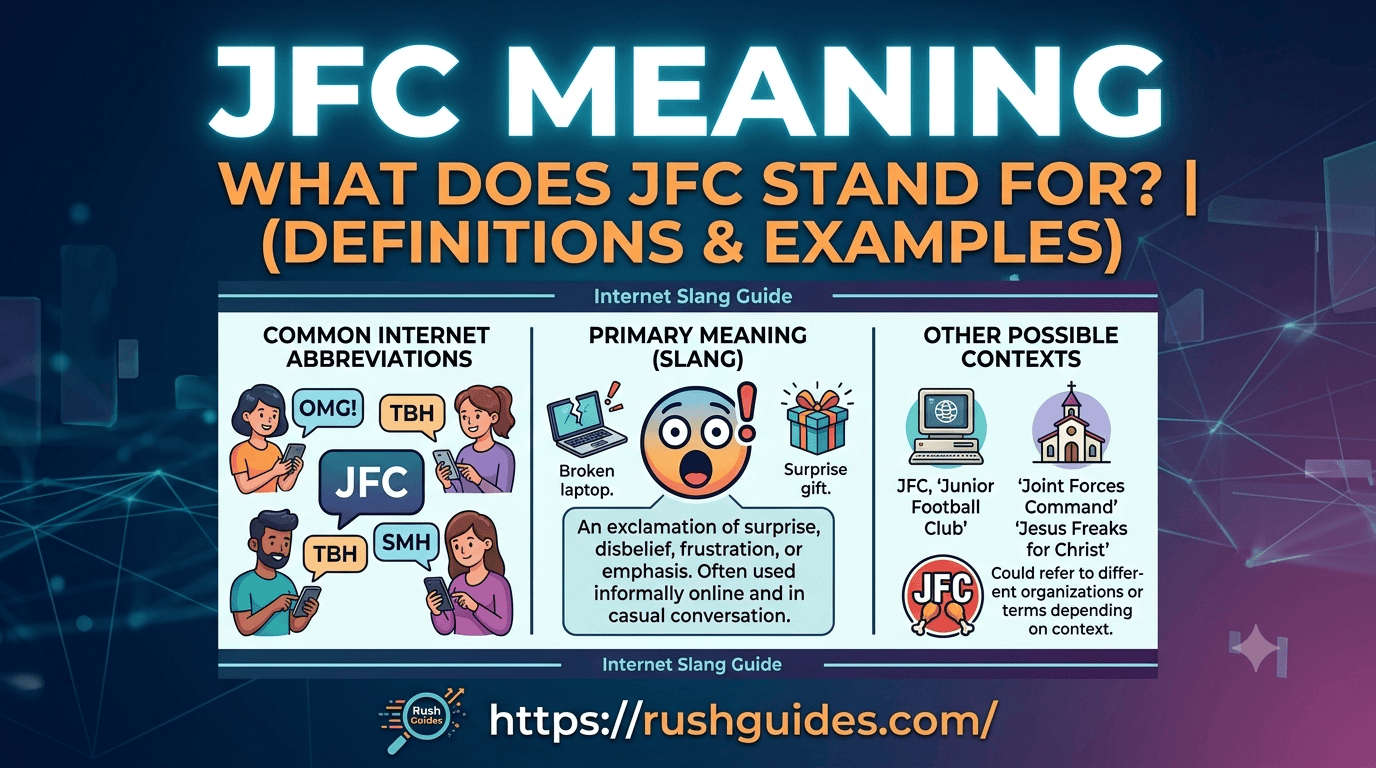
You’re scrolling through texts or Reddit and someone drops “JFC meaning” in all caps. Your first instinct? Google it. Here’s the thing: it’s blunt, it’s everywhere in digital communication, and knowing what it actually means can save you from awkward moments.
JFC stands for “Jesus fucking Christ” and is used as an exasperated exclamation in times of frustration or for emotional emphasis in informal contexts, especially digital communication. It’s not new slang it’s been around since the early internet days but it’s still one of the most recognizable reaction acronyms online in 2026.
This guide breaks down exactly what JFC means, where it comes from, how people use it across texts and social media, and what to do if you’re unsure whether to use it yourself.
What Does JFC Stand For?
JFC is a vulgar slang initialism that stands for “jesus fucking christ,” with origins unclear but used in online forums since at least the early 1990s and appearing on Urban Dictionary as early as 2003.
Before the acronym existed, the phrase itself had been used for decades. The profanity Jesus fucking Christ has been recorded as an exclamation for frustration, disgust, or anger since at least the 1920s. But as internet communication took off, people started shortening it to save keystrokes and fit character limits on text messages and social media.
Think of it like this: it’s the verbal equivalent of throwing your hands up in exasperation. The full phrase is strong, so the abbreviation carries that same emotional weight, even if you’re just typing three letters.
Why People Use JFC (And When They Mean It)
People don’t use JFC to be polite. It’s an emotional release. JFC works like saying “Oh my God” but much stronger and more intense, usually appearing during emotional moments in texting where something goes wrong suddenly or something shocking happens.
The tone depends on the situation:
When someone’s frustrated: Your coworker misses a deadline you’ve asked about five times. Your response: “JFC, seriously?” You’re annoyed, maybe exasperated, but not necessarily angry.
When something’s shocking: You see a headline that blindsides you. If a flight gets canceled, someone might respond “JFC, that’s awful” expressing surprise and sympathy.
When disbelief is the point: A movie ending completely surprises someone, and they might say “JFC, this movie ending completely surprised me” to express amazement.
Unlike some slang terms that change meaning based on context, JFC almost always carries the same emotional weight. What changes is the tone depending on the situation: annoyed tone when complaining, shocked tone when reacting to surprising news, or humorous tone when exaggerating a situation for effect.
The key is that it’s always a reaction to something. You won’t see JFC in casual conversation. You’ll see it when someone has an immediate, strong feeling they need to express.
Where You’ll See JFC
JFC appears frequently across Reddit, Discord, TikTok, gaming communities, social media platforms, and text messages because it delivers a strong emotional reaction in just three letters.
Texting: Between friends, JFC shows up when emotions run high. It signals “I’m not just mildly annoyed, I’m genuinely frustrated.”
Reddit and Gaming: JFC is widely used in gaming chats, Reddit comments, and Discord servers to show emotion like frustration, wow reaction, or disbelief reaction. Gamers especially love it because the gaming community runs on quick, casual language.
Social Media: On TikTok, Instagram, Twitter (now X), and similar platforms, users often react quickly to posts, and short emotional phrases spread easily because they fit perfectly into comments, captions, and tweets.
Why it stays common: Despite new slang appearing every year, JFC remains one of the most recognizable reaction acronyms online because internet communication continues to favor quick and expressive language.
When NOT to Use JFC
Here’s where it gets practical. Just because you understand it doesn’t mean you should use it everywhere.
Professional settings: If you’re emailing your boss, texting a client, or commenting on something work-related, JFC is off limits. It should generally be avoided in professional settings. Don’t use it in any work-related message, professional email, or anything formal and academic.
Mixed or public audiences: Posting publicly on platforms with mixed or unknown audiences is risky because you don’t know who’s reading, and JFC might come across as disrespectful or unprofessional.
Religious or older people: Talking to someone religious may find it disrespectful, and older family members unfamiliar with internet slang might be confused or bothered by it. Many people find JFC offensive because it combines profanity with religious language, making it especially problematic when you’re speaking to someone older, religious, or meeting them for the first time.
General rule: If you would not say the full phrase aloud, avoid typing JFC too.
Safe Alternatives That Deliver the Same Energy
Want to express strong emotion without profanity or religious reference? You’ve got options:
“Oh my goodness” Keeps the intensity without the vulgarity. Works in almost any situation.
“Wow, seriously?” Questions the situation while showing disbelief. Neutral and effective.
“Good grief” Classic, expresses frustration, and nobody finds it offensive.
“Are you kidding?” Implies shock or disbelief. Safe for most contexts.
“That’s wild” More casual, works especially well on social media.
These alternatives like “Oh my goodness,” “Good grief,” or “Wow, seriously?” all carry strong emotion without profanity.
The advantage of these alternatives: you can use them with your parents, your boss, or anyone else without worrying about landing wrong.
Real Examples of JFC in Action
To get a clearer picture, here’s how JFC actually appears in real conversations:
Scenario 1: Flight Cancellation
Person A: “My flight just got canceled.”
Person B: “JFC, that sucks. Where are you trying to go?”
Here, B is expressing sympathy and genuine frustration on A’s behalf.
Scenario 2: Gaming Fail
Person A: “I died to the same enemy three times in a row.”
Person B: “JFC, dude. Maybe take a break?”
Here, B is commiserating and also mildly teasing.
Scenario 3: Unbelievable News
Person A: “He quit his job without having another one lined up.”
Person B: “JFC, that’s reckless.”
Here, B is showing shock at poor decision-making.
The pattern is consistent: JFC appears when someone needs to react strongly and immediately.
Why JFC Stuck Around (Unlike Other Slang)
JFC first appeared in internet forums in the mid-2000s, spread through Reddit and 4chan around 2010-2015, and became mainstream American digital slang by 2020.
But why did it survive when so much slang dies out? As internet culture evolved, people began shortening longer phrases into acronyms for faster communication, and online forums in the early 2000s helped popularize it, with social media platforms later accelerating its use because short expressions fit perfectly into comments, captions, tweets, and text messages.
The simple answer: it does the job. JFC functions as a psychological shortcut for intense emotional expression, packing a surprising amount of emotion into just three letters.
Every year brings new slang terms, but the ones that survive are usually the ones that fill a real need. JFC nails that.
Is JFC Actually Offensive?
Yes, to some people. Because JFC contains profanity, it is considered vulgar and should be avoided in formal or professional settings. More specifically, many Christians find it disrespectful because it uses the name of Jesus paired with strong profanity, and it is always best to be mindful of your audience before using it.
The religious element matters. For people with strong faith, the phrase ties blasphemy and swearing together, which lands as genuinely insulting.
Outside of religious contexts, most younger internet users see it as just another emphatic expression—strong, yes, but not necessarily meant to shock. That said, intent and audience always matter. Using JFC casually in a friend group chat is different from using it in a comment section where strangers are watching.
The Bottom Line on JFC
JFC is one of the most recognized reaction acronyms in American digital slang in 2026, short, expressive, and instantly understood by most online users.
Here’s what you need to remember:
It means “Jesus fucking Christ.” It’s an emotional reaction, not a literal reference. It expresses shock, frustration, disbelief, or amazement depending on tone. It’s common in texts, Reddit, Discord, and social media comments. It should stay out of professional communication and mixed audiences. Some people find it offensive due to profanity and religious reference. You have safer alternatives if you want to express the same feeling.
Understanding internet slang helps you navigate online conversations without constantly Googling terms. But knowing what something means is only half the battle—knowing when and where to use it is the other half. With JFC, that means keeping it to casual spaces with people who actually speak the language of internet culture.
Read More About: Jessica Hardwick