Foenegriek has landed next to ashwagandha and maca on the list of herbs that TikTok gets excited about every few months. Some people swear it bumped their testosterone up, others use it to get their milk supply going after birth, and plenty of people just sprinkle it into a curry because it tastes good. So what part of this holds up, and what’s just marketing from a supplement brand that happens to sell capsules?
We went through the research literature, fact checks from VRT NWS and Factcheck Vlaanderen, and the safety database run by the Dutch pharmacovigilance center Lareb to figure out what foenegriek can and cannot do. The short version: it depends a lot on who you are and why you’re taking it.
What is foenegriek?
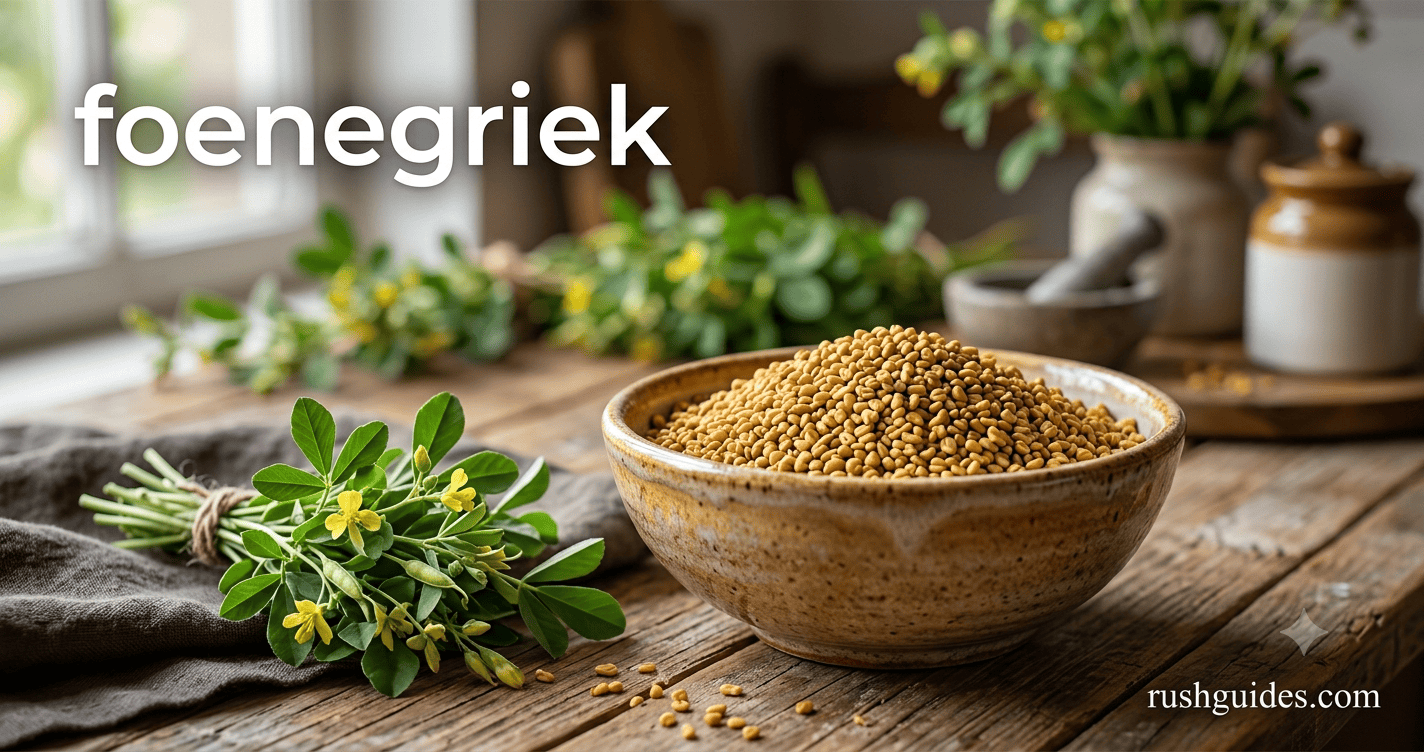
Foenegriek, known in English as fenugreek, is the common name for Trigonella foenum graecum, a plant from the legume family. That puts it in the same botanical group as peanuts and chickpeas, a fact that matters once you get to allergies. The plant is native to Southern Europe, West Asia and the Mediterranean region and people have used it for thousands of years, both in cooking and in traditional medicine systems like Ayurveda.
The seeds are small, angular and warm brown in color. They taste spicy with a hint of nuttiness and a touch of bitterness, and quite a few people say they remind them of maple syrup. That’s not a coincidence. The aromatic compound sotolon gives foenegriek that sweet, maple like scent, and the same compound is used to flavor imitation maple syrup.
You’ll find foenegriek in curry blends, in cheese, brewed as tea, eaten as sprouts, and increasingly as a capsule or powder supplement.
Foenegriek and testosterone: what does the research say?
This is probably the reason you clicked on this article. Foenegriek has been pushed in gym circles for years as a natural testosterone booster, and there’s now a decent stack of research to look at.
A study published in PLOS ONE in September 2024, run by researchers at the University of Oslo, followed 95 men between the ages of 40 and 80 for 12 weeks. Participants took a daily dose of 0, 600, 1200 or 1800 mg of foenegriek extract. Saliva testosterone rose by 31.1 percent compared to baseline and by 37.2 percent compared to the placebo group. Total plasma testosterone also increased against baseline, though the difference against placebo did not quite reach statistical significance.
Another study, run at KVTR Ayurveda College in India and posted on medRxiv this year, tested a dose of 275 mg of foenegriek extract taken twice a day after meals for 8 weeks in 43 men doing resistance training. This trial looked at muscle strength, endurance and testosterone alongside athletic performance markers.
An earlier meta analysis from 2020, published in Phytotherapy Research, pooled four randomized clinical trials and found that foenegriek extract had a significant effect on total serum testosterone in men. Four trials is a fairly small evidence base, and the extracts and doses tested varied quite a bit between studies.
One point worth flagging: in the Oslo trial, testosterone went up but libido did not budge. Higher testosterone numbers don’t automatically translate into a stronger sex drive.
The likely mechanism sits with the saponins in foenegriek, particularly protodioscin. These furostanolic saponins may inhibit the enzyme 5 alpha reductase, which converts testosterone into DHT, potentially leaving more free testosterone in circulation. That’s a reasonable explanation, but the evidence is still developing and the effect size swings from study to study.
Bottom line for the gym crowd: there’s solid research pointing to a modest positive effect on testosterone in men, mostly measured through saliva. Don’t expect it to feel like a cycle. Think of it as a small addition on top of good food, sleep and strength training, not a replacement for any of them.
Foenegriek and blood sugar
Beyond the testosterone angle, foenegriek has been studied for its effect on blood sugar for far longer, and this is actually the use case with the longest research history. The herb appears to lower the amount of glucose in the blood, which makes it interesting for people managing diabetes. Research points to a favorable effect on blood sugar regulation, making it potentially useful for people with diabetes, though it should always be treated as a supplement to medication and a proper diet rather than a substitute.
Taking blood sugar lowering medication? Check with your doctor before adding foenegriek, since the combination can push blood sugar too low.
Does foenegriek really help with breast milk?
This is probably the oldest traditional use of foenegriek, and also the most debated one right now. On TikTok, the herb gets promoted as a natural fix for women, with claims about boosted milk supply, lighter periods and relief from menopause symptoms.
Factcheck.Vlaanderen and VRT NWS looked closely into these claims in early 2025 and came back with a sober conclusion. The claimed benefits for women, such as stimulating breast milk and reducing menstrual and postmenopausal complaints, have not been scientifically proven. The European Medicines Agency confirmed to the fact checkers that the available studies are too limited in size and duration to draw firm conclusions.
That said, the picture isn’t entirely negative. Other sources point to a meta analysis that did find some indication foenegriek can support milk production, and note that research so far hasn’t turned up harmful effects for mother or baby. What has been reported are milder side effects, including nausea, vomiting and an unusual smell or taste to the breast milk.
The safety database Medicineh puts it plainly: foenegriek is considered possibly safe when taken by mouth to increase milk flow in the short term, and research shows that 1725 mg of foenegriek taken three times a day for 21 days did not cause side effects in infants.
Put together, foenegriek seems unlikely to harm a baby with normal postpartum use, but the proof that it actually works as a galactagogue is thinner than the TikTok clips suggest.
Other claimed benefits, backed by partial evidence
Beyond testosterone, blood sugar and breast milk, a handful of other claims keep coming up. Here’s what the research actually says about each.
Digestion. There are signs that certain compounds in foenegriek support the gut lining and stimulate bowel movement, largely thanks to its high fiber content.
Anti inflammatory and cholesterol lowering effects. Thanks to flavonoids, alkaloids like trigonelline, coumarin and saponins, foenegriek may have anti-inflammatory, pain relieving and diuretic properties, alongside possible antimicrobial and cholesterol lowering effects.
Liver protection. Research from Stichting Orthokennis, mostly based on animal models, shows foenegriek seed can protect liver cells against alcohol induced damage and protect the testes and liver against damage caused by cadmium. Keep in mind these are animal and in vitro studies, so this doesn’t automatically transfer to humans.
Appetite. Foenegriek may have a positive effect on appetite, which could make it useful for people who have lost weight due to a lack of appetite.
Muscle mass with age. A group of researchers reviewing the available studies concluded that foenegriek appears to have a mild anabolic effect and may somewhat amplify the results of strength training, which makes it interesting for women going through menopause trying to hold onto muscle mass.
Dosage: how much foenegriek should you take?
There’s no official recommended daily amount, because the right dose depends on what you’re using it for and which form you’re taking.
| Form | Typical dose | Used for |
| Ground seed or powder | 500 to 2000 mg per day | General health, digestion |
| Standardized extract | 150 to 600 mg per day | Testosterone, hormonal support |
| Extract in testosterone trials | 275 mg twice daily to 600 mg per day | Strength training, testosterone |
| Tea | 1 teaspoon of seeds per cup, up to 3 cups | Digestion, general wellbeing |
| While breastfeeding | Around 1725 mg, three times a day | Boosting milk supply |
The literature suggests that 5 to 10 grams of foenegriek seed can be used safely over multiple years, and doses up to 1 gram of extract appear safe over a period of several months. Start low and build up slowly, and take it with or after a meal if it upsets your stomach.
Who should skip foenegriek
Under normal use, foenegriek is generally considered safe, but that doesn’t mean it carries zero risk for everyone.
The most common mild side effects are diarrhea, stomach upset, bloating, gas, dizziness, headache and a maple syrup smell in the urine. Some people get nasal congestion, coughing, wheezing or facial swelling if they’re sensitive to it.
A few groups should either avoid foenegriek or check with a doctor first, no exceptions.
- Pregnant women. This is the biggest warning. Research indicates foenegriek can raise the risk of fetal malformation or fetal loss, and it may trigger uterine contractions that induce labor. Both VRT NWS and Factcheck Vlaanderen advise avoiding foenegriek during pregnancy.
- People taking blood thinners. A high dose of foenegriek seed can strengthen the effect of blood thinning medication, raising bleeding risk.
- People allergic to peanuts or chickpeas. Because foenegriek belongs to the same plant family, people allergic to other legumes such as soybeans, peanuts and green peas may also react to foenegriek.
- Anyone under 18. Safety data for this age group is missing, so use is not recommended for minors.
- People with diabetes on medication. As mentioned above, combining foenegriek with blood sugar lowering drugs can push blood sugar too low.
[Internal Link: RushGuides article on natural testosterone boosters and whether they actually work]
How to actually use foenegriek
There are several ways to work foenegriek into your routine, depending on whether you want it in your kitchen or your supplement stack.
- As a spice. Briefly toast the seeds in a dry pan for extra flavor and add them to curries, marinades or sauces.
- As for tea. Pour hot water over a teaspoon of seeds and let it steep for 5 to 10 minutes.
- As a capsule or extract. Go for a standardized extract from a trusted brand if you’re specifically after testosterone or hormonal support, and follow the label dose.
- As sprouts or fresh leaves. Fresh leaves add a light bitter edge to salads.
Frequently asked questions about foenegriek
Does foenegriek really raise testosterone?
Multiple randomized trials, including a large study out of Oslo with 95 men, show a measurable rise in saliva testosterone at doses between 600 and 1800 mg of extract per day. The effect on total blood testosterone is less consistently proven, and libido did not improve in that same study.
Can I take foenegriek during pregnancy?
No. Both fact checkers and medical sources advise against it because of the possible risk of early labor and effects on the developing fetus.
Does foenegriek actually help with breastfeeding?
Traditional use is widespread and some research points toward support for milk production, but the scientific evidence is still limited in scale. Side effects for mother or baby have not been widely reported under normal use.
Is foenegriek safe to combine with other supplements?
Generally yes, but be careful with blood thinners and blood sugar lowering medication. Check with a doctor or pharmacist if you’re not sure.
How much foenegriek per day is too much?
Doses above 10 grams per day can cause side effects like diarrhea or a noticeable maple syrup body odor. Stick to the recommended dose printed on your supplement label.
The takeaway
Foenegriek isn’t a miracle supplement, but it isn’t empty hype either. For men doing strength training, there’s fair research pointing to a modest testosterone bump, mostly measured through saliva. For blood sugar management, the evidence base is the strongest of the bunch. For claims around periods, menopause and breast milk, the science is still thin, no matter what social media wants you to believe. Check your dose, skip it if you’re pregnant or on blood thinners, and treat it as an addition to a solid lifestyle rather than a substitute for one.
Read More About: Florida Woman Wins Monopoly Lottery