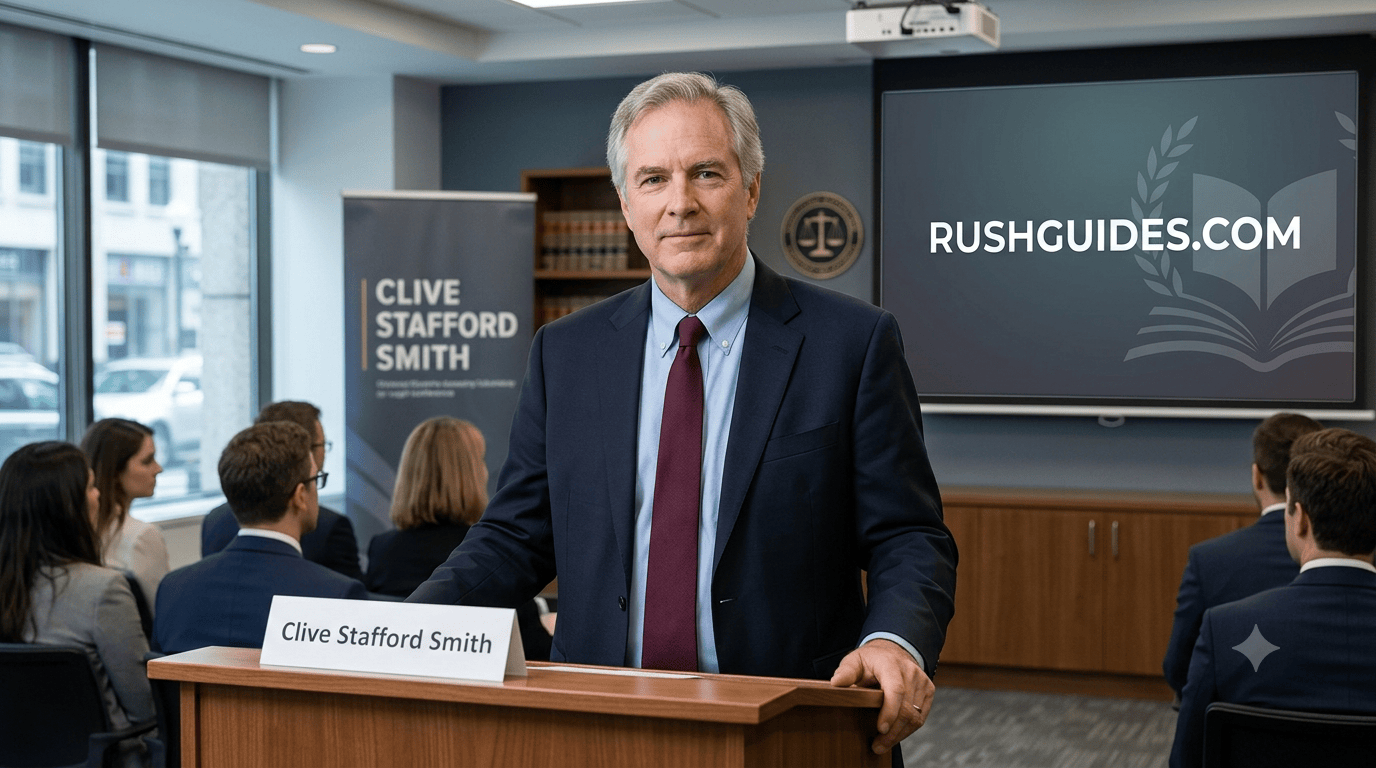
There aren’t many people who have gone head to head with the U.S. government over capital punishment, won, and then turned around and taken on Guantánamo Bay for good measure. Clive Stafford Smith OBE, born on 9 July 1959, is a British attorney who specialises in civil rights and working against capital punishment in the United States. But to call him simply a “civil rights lawyer” wildly undersells what he’s actually done.
Over four decades, Stafford Smith has become one of the most consequential human rights advocates alive, a man who has walked into the worst prisons on earth and come back with lives saved. His story is part legal thriller, part moral reckoning, and entirely worth knowing.
Early Life and Education
Born in Cambridge and educated at Old Buckenham Hall School and Radley College, Clive Stafford Smith studied journalism as a Morehead Scholar at the University of North Carolina at Chapel Hill, then followed that degree with a law degree at Columbia University in New York.
That combination of journalist’s instinct and legal precision would define his career. He didn’t just argue cases in court rooms. He investigated them, wrote about them, and dragged them into the public eye when the courtrooms failed.
After graduating from Columbia Law School, Clive spent nine years as a lawyer with the Southern Center for Human Rights working on death penalty cases and other civil rights issues. This wasn’t exactly a career path that came with a big salary or prestige. It came with clients on death row in Louisiana, Mississippi, and other southern states people nobody else wanted to touch.
The Death Row Years: A 98% Record
Here’s a number that barely seems real: in total, Clive has represented over 300 prisoners facing the death penalty in the southern United States. He only took on the cases of those who could not afford a lawyer, and always the most despised, yet he prevented the death penalty in all but six cases, a 98% “victory” rate.
That isn’t just impressive. That’s extraordinary, especially given who he was representing. These weren’t high-profile clients with expensive PR teams. These were people the system had already written off.
This record was achieved through exhaustive investigations into mitigating factors such as intellectual disabilities and flawed forensic evidence. Stafford Smith didn’t just file appeals. He dug. He found the things that lazy or underfunded defence lawyers had missed, and he used them.
One of his most notable cases involved Shareef Cousin. Stafford Smith’s efforts contributed to the 1999 exoneration of Shareef Cousin, a 16-year-old convicted in 1996 of a New Orleans murder based on eyewitness testimony that was later recanted and evidence that had been withheld by prosecutors. Working through the Louisiana Capital Assistance Center, which he co-founded in 1993, Stafford Smith helped uncover prosecutorial misconduct, leading to Cousin’s death sentence being vacated and charges dismissed after DNA and forensic reanalysis undermined the conviction.
He has also taken five cases to the U.S. The Supreme Court, and every single one of those people prevailed.
Building Reprieve: Fighting the System Institutionally
Stafford Smith recognised early that individual victories, however meaningful, wouldn’t change the structure. So he built something bigger.
Clive co-founded Reprieve with Paul Hamann in 1999, following their work on the BBC documentary 14 Days in May in 1987. That documentary had followed an American prisoner in the days before his execution and it changed both men permanently.
3DCentre, a United Kingdom-based non-profit charity dedicated to combating injustice through legal advocacy, individual case representation, and youth empowerment initiatives, was established by Stafford Smith in 2014 following his departure from Reprieve after 15 years as its director. The organisation is based in Dorset, combining legal work with educational programmes including a 10-week human rights summer internship run in collaboration with the University of Bristol.
Guantánamo Bay: Taking on the U.S. Government
If the death row work was where Stafford Smith made his name, Guantánamo is where he made history.
After the September 11 attacks, the U.S. set up a detention facility at Guantánamo Bay in Cuba, specifically designed to exist outside the reach of American courts. After the first prisoners arrived at Guantánamo in 2002, the Bush administration claimed that the Geneva Convention did not apply. As a result, the detainees were denied access to lawyers and the right to challenge their detention.
Stafford Smith wasn’t having it. Reprieve’s founder Clive Stafford Smith and two other lawyers successfully challenged President Bush in the Supreme Court. They won access to Guantánamo, opened it up and began representing the prisoners held there.
To date, Clive has helped secure the release of 69 prisoners from Guantánamo Bay, including every British prisoner. No other lawyer or law firm comes close to that number.
He has spent his career working against the death penalty in the United States, along with representing more than 80 Guantánamo Bay detainees. His clients have included Shaker Aamer, Moazzam Begg, Binyam Mohammed, and Sami Al Hajj, the Al Jazeera journalist detained for six years without charge.
What he found inside Guantánamo, and what he said about it publicly, was explosive. He described prisoners being force-fed through nasal tubes twice a day, with the tubes deliberately removed and reinserted each time to maximise discomfort. He testified before Congress. He wrote op-eds. He did everything short of picking up a megaphone and standing outside the White House.
In a September 2025 Gresham College lecture titled “Lessons from Guantánamo Bay,” he argued that public opinion exerts greater influence than courts in resolving indefinite detentions, drawing from his representation of detainees to illustrate how legal victories often require broader societal pressure.
That’s a blunt lesson from someone who’s seen both tools up close.
The Books: Bringing It to a Wider Audience
Stafford Smith didn’t keep his knowledge locked inside legal briefs. He wrote.
His most widely read books include Bad Men: Guantánamo Bay and the Secret Prisons (2007), which was shortlisted for the Orwell Prize, and Injustice: Life and Death in the Courtrooms of America (2012). In Injustice, Stafford Smith examined the case of Kris Maharaj, a British citizen sentenced to death in Florida for a double murder, to expose problems in the justice system. The book reveals disturbing details, including anomalies in the prosecution files witnesses with exculpatory testimony who were never called, falsified and suppressed evidence. Maharaj’s death sentence was later commuted to life without parole.
These aren’t dry legal textbooks. They’re human documents about what happens when systems fail people, and what one very determined lawyer does about it.
Awards and Recognition
The accolades have piled up over the years, though Stafford Smith has never seemed particularly interested in collecting them.
He received the OBE for humanitarian services in 2000, a Lifetime Achievement Award from The Lawyer magazine in 2003, the Gandhi Peace Award in 2004, a Lannan Foundation Cultural Freedom Award in 2008, the International Freedom of the Press Award in 2009, and the International Bar Association’s Human Rights Award in 2010.
He also received the Contrarian Prize in 2014. That last one probably fits him best of all.
He was ranked sixth on the 2009 list of Britain’s Most Powerful Lawyers by The Times and third on The Lawyer‘s “High Profile” British lawyer list the same year.
What Makes Clive Stafford Smith Different
Plenty of lawyers argue for human rights. Stafford Smith actually gets people out.
There’s a pattern to his approach that runs through everything. He goes to places others won’t go to the worst death rows, the most controversial detention camps. He takes the clients nobody else wants. He loses, sometimes badly, and keeps going. And he makes noise, because he understands that courts alone won’t fix what’s fundamentally a political problem.
In one interview, he drew a direct parallel between the death penalty and Guantánamo, arguing that both represent political responses to fear ways of punishing a visible minority to convince the public something is being done, rather than addressing root causes. That’s a perspective shaped by decades of watching the system work up close, from the inside.
He has never been paid by a client. That’s worth saying again: across 40-plus years of legal work, on hundreds of cases, representing some of the most despised people in America and beyond, Stafford Smith has never taken a fee from a client.
Clive Stafford Smith Today
Now in his mid-60s, Stafford Smith hasn’t slowed down. Through his 3DCentre in Dorset, he continues to take on cases involving prolonged detention without charge. One notable recent example was his involvement in the 2023 release of the Rabbani brothers after 20 years of detention without trial or conviction.
He continues to lecture and speak publicly. An October 2024 Gresham College lecture examined marginalised groups in policy debates, critiquing systemic biases in labelling and treatment.
The causes have expanded, but the core argument remains the same: due process isn’t optional. It doesn’t apply only to people you like, or people whose innocence seems probable, or people who come from the right country. It applies to everyone, and if it doesn’t, it applies to no one.
FAQ
Who is Clive Stafford Smith?
Clive Stafford Smith OBE is a British attorney born in 1959 who specialises in civil rights and capital punishment, representing death row prisoners in the southern United States and detainees at Guantánamo Bay.
What is Reprieve?
Reprieve is the non-profit organisation Clive Stafford Smith co-founded in 1999 with Paul Hamann, following their collaboration on a 1987 BBC documentary. It challenges human rights abuses in courts around the world.
How many death row clients has Clive Stafford Smith represented?
He has represented over 300 prisoners facing the death penalty in the southern United States and prevented execution in all but six cases, a success rate of approximately 98%.
What is the 3DCentre?
The 3DCentre is a UK-based non-profit Stafford Smith established in 2014 after leaving Reprieve, focused on legal advocacy, individual case representation, and youth empowerment, headquartered in Dorset.
Has Clive Stafford Smith won awards?
Yes. His awards include the OBE (2000), the Gandhi Peace Award (2004), a Lannan Foundation Cultural Freedom Award (2008), the International Freedom of the Press Award (2009), and the International Bar Association’s Human Rights Award (2010), among others.
Read More About: Claude Edward Elkins Jr