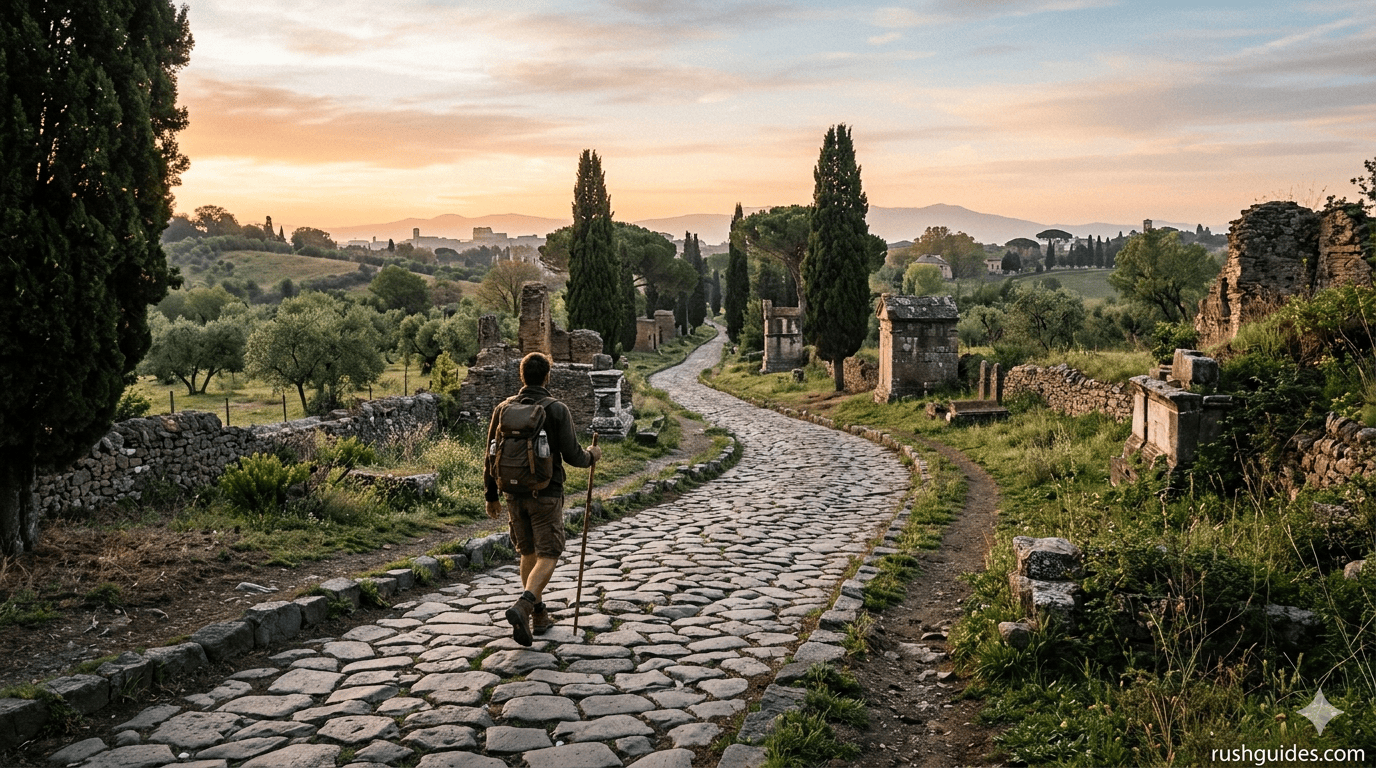
You’ve probably driven down a road today without giving it a second thought. Smooth tarmac, lane markings, drainage channels on the sides. Standard stuff. What you might not know is that the road you’re on could literally be following a path laid down by Roman engineers over 2,000 years ago.
That’s what cesta roman means. Translated from older European usage, it points to Roman roads, the vast network of stone highways that the Roman Empire used to conquer, connect, and control the known world. “Cesta” means road or path in several Slavic and Romance-influenced languages, and paired with “Roman,” it’s become a widely used modern shorthand for one of history’s greatest feats of infrastructure. The Romans themselves called them viae Romanae, but the concept is the same.
The Romans built 50,000 miles (80,000 km) of hard-surfaced highway, primarily for military reasons, and that number only covers the paved major routes. Recent research has raised estimates of the full Roman road network to nearly 185,896 miles across almost 1,544,409 square miles when secondary and rural tracks are included. That’s roughly the distance from Earth to the Moon and back, laid in stone.
Why the Romans Built Roads at All
The Romans didn’t build roads out of civic generosity. They built them because an army that can’t move quickly loses wars.
Roman roads were mainly military works, built for strategic purposes, intended to facilitate the dispatching of supplies to the frontier and the massing of troops in the shortest possible time. When commanders needed to know how long it would take to move an army from point A to point B, they had actual answers. From Cologne to Rome was 67 days, Rome to Brindisi was 57 days, and Rome to Syria (including two days at sea) was 124 days. That kind of precision planning only works when your road network is consistent and reliable.
Over time, of course, the roads became much more. Merchants used them to move goods. Officials used them to govern distant provinces. Tax collectors reached rural areas. Ordinary people traveled between cities. The network of public Roman roads covered over 120,000 km, and it greatly assisted the free movement of armies, people, and goods across the empire.
Roads were also a statement. They said: Rome was here, Rome built this, and Rome isn’t going anywhere.
How Cesta Roman Roads Were Actually Built
This is where things get genuinely impressive. Roman road construction wasn’t just “lay some stones and call it a day.” It was a multi-layered, precision engineering process that most modern roads still haven’t matched for longevity.
Step One: Surveying
Before a single stone was moved, specialist surveyors called agrimensores (or mensores) mapped out the route. The incline of a road could not exceed 8 degrees in order to facilitate the movement of heavy carts packed with goods. To measure slopes, mensors employed a device called a khorobat, a 6-metre ruler with a groove on top. They also used a tool called a groma to lay out perfectly straight lines over large distances.
The Romans had a simple philosophy: go straight. If there was a mountain in the way, cut through it. If there was a marsh, drain it. When crossing flat land, the road was as straight as possible: the ancient Appian Way, between Rome and Terracina, includes an uninterrupted straight line 56 miles long.
Step Two: The Layers
A first-class paved road, what the Romans called a via munita, was built in four distinct layers, each with a Latin name.
Here’s how it broke down, from bottom to top:
Statumen – The foundation. Large flat stones set in mortar, up to 30 centimetres deep. This layer handled structural load.
Rudus – A layer of broken stones and cement, packed down to form a stable middle bed.
Nucleus – Finer gravel or concrete, smoothed flat and slightly cambered (curved upward in the centre) so water would run off to the sides. Drainage wasn’t an afterthought; it was baked into the design at every layer.
Summum Dorsum – The wearing surface. On the great paved highways this was an interlocking layer of polygonal basalt, lava, or limestone slabs, fitted so closely a knife-blade couldn’t pass between them.
Roman roads varied in thickness, but the typical road was around 3 to 5 feet (1 to 1.5 metres) thick. The road was typically about 4.2 metres wide, enough for two carts to pass, flanked by raised stone curbs, gravel footpaths, and drainage ditches. At regular intervals, mounting blocks were set into the curb to help travellers climb onto their horses.
The genius of this system, as noted by the team at roman-empire.net, was redundancy. Any single layer could fail, a flagstone could crack, a piece of gravel could wash out, and the road would still function. Modern asphalt, by comparison, is essentially one layer over a base. A single freeze-thaw cycle can ruin it.
The Most Famous Roman Roads
Not all cesta roman roads were equal. Some became legends.
Via Appia (The Appian Way)
The first and most famous great Roman road was the Via Appia. Constructed from 312 BCE and covering 196 km (132 Roman miles), it linked Rome to Capua in as straight a line as possible and was known to the Romans as the Regina viarum, or Queen of Roads.
It was later extended south to the port of Brindisi, giving Rome a 360-mile stone corridor to the sea routes of Greece. The Via Appia still contains the longest stretch of straight road in Europe: 62 km without a bend.
Via Flaminia
Built in 220 BCE by the censor Gaius Flaminius, this road ran northeast from Rome to the Adriatic coast. It was a key military supply route during campaigns in northern Italy. The Furlo Pass tunnel on the Via Flaminia, cut by Vespasian’s engineers in AD 77, is still in use 1,950 years later as part of the modern Italian state highway system. It runs 38 metres straight through solid limestone. That sentence deserves a moment of appreciation.
Via Domitia
The Via Domitia connected the Italian peninsula with Hispania. It was commissioned in 118 BCE under Gnaeus Domitius Ahenobarbus, and it ran across southern Gaul, enabling fast communication with western provinces. You can still find sections of it visible near Narbonne in France today.
Via Egnatia
In the Balkans, the Via Egnatia allowed troops and traders to travel from the Adriatic coast to the Hellespont, with onward passage by sea to Byzantium. This route was essentially Rome’s highway to Greece, Turkey, and beyond.
Cesta Roman Roads That Still Exist
This is the part that tends to stop people mid-sentence. Some of these roads are still physically there.
Across Europe, Asia, and Africa, several roads within this network still exist today, including the Via Augusta in Spain, Stane Street in England, and Via Domitia in France.
In Britain, the M20 motorway in Canterbury runs above a road known as Stone Street, one of the major Roman routes through the province. The Romans called the city Londinium, and their roads converged there, just as they do in modern London.
In Germany, the oldest still-standing bridge in the country is Roman: the Manfred Bridge in Trier, a UNESCO World Heritage site that spans the river Moselle and is believed to date to the second century CE.
In many parts of Europe and the Mediterranean, modern highways, country lanes, and even city streets still follow routes first laid down by Roman engineers nearly two thousand years ago. The reason isn’t sentimentality. It’s that the Romans picked the best routes through the terrain, and those routes are still the most logical ones.
Why Roman Roads Lasted So Long
Three things kept these roads functional for over a millennium: engineering philosophy, institutional support, and obsessive maintenance.
On the engineering side, the layered construction managed water brilliantly. Roman roads lasted because they were engineered for stability and water control: deep preparation, layered construction, durable materials, and effective drainage. Water is the enemy of roads. It freezes, expands, and cracks. Roman drainage systems moved water away from the road surface before it could do damage.
On the institutional side, major Roman roads were the property of the Roman state. Responsibility for oversight increasingly fell to appointed officials known as curatores viarum, who inspected roads, organised repairs, and enforced standards. These weren’t just roads; they were legally protected state infrastructure with named bureaucrats accountable for keeping them up.
Roads were also a highly visible indicator of Rome’s power, and they indirectly helped unify a vast melting pot of cultures, races, and institutions. You don’t let symbols of power fall into disrepair.
The Legacy That Outlasted the Empire
Rome fell. Its roads didn’t.
Many of the Romans’ long straight roads across their empire have become famous names in their own right. Roman roads included bridges, tunnels, viaducts, and many other architectural and engineering tricks to create a series of breathtaking but highly practical monuments which spread from Portugal to Constantinople.
Medieval paths, early modern turnpikes, and modern highways frequently reused Roman alignments because they remained the most efficient routes through the terrain. Even where the paving stones have vanished, the underlying logic of the road endures.
The phrase “all roads lead to Rome” isn’t just a metaphor. It was literally true. From the Milliarium Aureum, a gilded marble column erected in the Roman Forum by Emperor Augustus in 20 BCE, distances across the empire were measured. Every milestone on every cesta roman traced its number back to that single point.
You don’t build something that lasts 2,000 years by accident. You build it by caring more about the work than the shortcut.
FAQ: Cesta Roman
What does cesta roman mean?
It translates loosely to “Roman road” or “Roman path.” The word “cesta” means road or path in several European languages, and “Roman” connects it to ancient Rome’s legendary infrastructure. The Romans themselves used the Latin term viae Romanae.
How many miles of roads did the Romans build?
The Romans built over 53,000 miles of paved roads, stretching from Scotland to East Europe to Mesopotamia and North Africa. Including secondary and unpaved routes, estimates now put the full network at around 185,896 miles.
Are any Roman roads still usable today?
Yes. The Via Appia Antica, the longest and oldest Roman road, is still in use today, over 2,000 years later. Several others survive in Spain, France, England, and Italy.
Why were Roman roads so straight?
Straight roads are shorter, faster to march armies along, easier to defend, and quicker to build than winding alternatives. The Romans prioritised directness above almost everything else in their route planning.
Who built Roman roads?
Primarily Roman legions during military campaigns, supplemented by local labour. Before construction began, Roman surveyors carefully planned each road, and the work was authorised by the Senate and overseen by senior magistrates such as censors and praetors.
What made Roman road construction different from earlier roads?
The multi-layer construction system, drainage engineering, use of pozzolanic concrete, and the institutional framework for maintenance and oversight. Earlier roads were often simple tracks. Roman roads were engineered systems.
Read More About – Ceıvır